 2023, Vol. 47
文章信息
- 刘明杰, 高亚平, 张玉, 岳世栋, 周毅. 2023.
- LIU Ming-jie, GAO Ya-ping, ZHANG Yu, YUE Shi-dong, ZHOU Yi. 2023.
- 除草剂对海草的影响研究进展
- A review of the effects of herbicides on seagrass
- 海洋科学, 47(4): 165-175
- Marine Sciences, 47(4): 165-175.
- http://dx.doi.org/10.11759/hykx20220613001
-
文章历史
- 收稿日期:2022-06-13
- 修回日期:2022-08-23


2. 中国水产科学研究院黄海水产研究所, 山东 青岛 266071;
3. 青岛海洋科学与技术试点国家实验室 海洋生态与环境科学功能实验室, 山东 青岛 266237;
4. 中国科学院海洋大科学研究中心, 山东 青岛 266071;
5. 中国科学院海洋牧场工程实验室, 山东 青岛 266071;
6. 中国科学院大学, 北京 100049;
7. 山东省实验海洋生物学重点实验室, 山东 青岛 266071
2. Yellow Sea Fisheries Research Institute, Chinese Academy of Fisheries Sciences, Qingdao 266071, China;
3. Laboratory for Marine Ecology and Environmental Science, Pilot National Laboratory for Marine Science and Technology (Qingdao), Qingdao 266237, China;
4. Center for Ocean Mega-Science, Chinese Academy of Sciences, Qingdao 266071, China;
5. CAS Engineering Laboratory for Marine Ranching, Institute of Oceanology, Chinese Academy of Sciences, Qingdao 266071, China;
6. University of Chinese Academy of Sciences, Beijing 100049, China;
7. Shandong Province Key Laboratory of Experimental Marine Biology, Qingdao 266071, China
海草是一种能够适应沉水生活的高等单子叶植物, 全球约有70余种, 隶属6科13属, 生长在除南极洲以外所有大洲的河口、泻湖和沿岸浅海水域[1], 分布总面积约为160 378~266 562 km2[2]。单种或多种海草大面积连续分布构成的海草床[3], 是典型的沿海生态系统之一, 具有重要的生态功能[4]: 能够为众多的海洋生物提供栖息地和食物来源, 是海洋经济鱼类的育幼场[5]; 对全球的碳封存起着重要作用, 是碳储存的关键场所[6]; 可以显著减少人类、鱼类和无脊椎动物接触细菌病原体的机会[7]。
近年来, 受气候变化以及人类活动的影响[4, 8-12], 全球范围内海草床生态系统迅速衰退, 多种海草濒临灭绝, 海草床分布面积锐减[4, 13], 自1990年以来, 海草正以每年7%的速率退化消失[8]。除草剂的滥用是威胁海草生存的重要原因之一, 给海草床生态系统带来了不可忽视的影响[14-17]。Bester等[18]认为德国瓦登海海草床的减少可能与除草剂污染有关, Hughes等[19]发现暴露在除草剂敌草隆中的鳗草(Zostera marina)更容易被细菌感染。此外, 除草剂还可能通过食物链进一步影响海草床内分布的各种动物如儒艮、海龟等[20]。
除了在农业生产过程中大量使用, 除草剂如Irgarol 1051(氯苯酚)、Diuron(敌草隆)等被直接用作船舶的防污涂料[20-22], 草甘膦等被用于防治互花米草等外来生物的入侵[23-25]。除草剂使用量和排放量的增加导致其在河口和近岸海域残留, 残留的除草剂会被海草、藻类等非靶标生物吸收, 抑制海草等初级生产者的光合作用、蛋白质和脂类合成等过程, 从而影响植物的生长[23, 26], 继而对海草床、红树林、珊瑚礁等沿海生态系统产生危害[17, 21, 27-29]。
我国沿海具有丰富的海草资源, 但近年来退化趋势加剧, 海草床大面积衰退[3, 10-11, 30-33]。因此探究除草剂对海草的危害以及胁迫机理对于我国海草资源的保护具有重要的意义。本文回顾了近40年来除草剂对海草胁迫的相关研究工作, 分析了国内外海草床中除草剂的残留现状, 总结了除草剂对海草的作用特点, 并对今后的研究提出了展望, 有助于全面了解海草与除草剂胁迫之间的关系, 为将来开展更深入的研究工作提供参考。
1 海草床除草剂残留情况20世纪90年代, Scarlett等[20]在澳大利亚东部沿海的海草组织中检测出了除草剂Irgarol 1051, 最高含量达118 ng/g(叶片湿重计)。随后Haynes等[15]和McMahon等[16]又分别在海草床的沉积物、表层海水和海草组织中检测出了除草剂阿特拉津(Atrazine)和敌草隆, 且海草组织中敌草隆的浓度高于沉积物中的浓度, 进一步提出了残留的除草剂可能会对当地的海草群落产生影响。Espel等[34]曾在地中海沿岸泻湖的沉积物和表层海水中检出28种除草剂, 且冬季海草根状茎中的淀粉含量与水体中除草剂浓度呈负相关, 表明除草剂等有机污染物的残留是导致草床退化的原因之一。此外, 澳大利亚大堡礁[35-37]、法国阿卡雄湾[14]、德国瓦登海[18]、美国切萨皮克湾[38]以及西印度洋沿岸[28]等地均曾报道检出多种除草剂残留, 该残留可能对当地海草床生态系统产生危害。
国内对于海草床中除草剂残留的研究相对较少。任传博等[39]对渤海某海域60个站位的海水样品进行了采样分析, 其中阿特拉津、扑草净、莠灭净的检出率为100%。张望等[40]对海州湾沿岸海水中16种三嗪类除草剂、5种酰胺类除草剂的残留情况进行了调查, 结果发现阿特拉津和扑草净的检出率分别达到100%和80%。徐英江等[41]调查发现莱州湾海域43个站位表层海水中阿特拉津、扑草净、扑灭津、莠灭净4种除草剂及脱乙基阿特拉津平均浓度分别为31.3、6.49、1.57、12.4和9.14 ng/L。Dsikowitzky等[42]在海南岛东北部的八门湾和周边海域的海草床内检出了多种三嗪类除草剂, 其中扑草净浓度最高达440 ng/L。我国北方海草分布的重要海湾——桑沟湾中也曾检测出阿特拉津的残留[43]。
从国内外相关研究结果来看, 海草床生态系统正在全球尺度上面临着除草剂残留的威胁。虽然在某些海域中除草剂检出浓度较低, 短时间内不会有较高的生态风险[14, 40-43], 但若长期处于低浓度除草剂的胁迫之下, 仍可能影响海草床在应对其他威胁(如台风等极端天气)时的抵抗和恢复能力, 使海草床生态系统变得更为敏感和脆弱[14, 35, 44-46]。
2 除草剂对海草的作用特点除草剂的类型繁多, 不同类型除草剂对植物有不同的作用方式。如表 1所示, 在过去40多年中, 光系统Ⅱ(PSⅡ)型除草剂如阿特拉津、敌草隆等在沿海水域被频繁检出[14-16, 20, 26], 因此针对上述除草剂开展的相关研究也最多。光系统Ⅱ型除草剂是一类具有相同作用模式的除草剂, 其会与PSⅡ上的D1蛋白结合, 抑制电子转运, 从而影响海草的光合作用, 限制碳的固定[21], 其他类型除草剂如草甘膦会抑制芳香族氨基酸的合成, 从而抑制植物体蛋白质的合成[26]。海草通过根和叶吸收水体或沉积物中残留的除草剂并在体内累积[20, 23], 不同类型除草剂会对不同种类海草表现出不同的毒性效应。
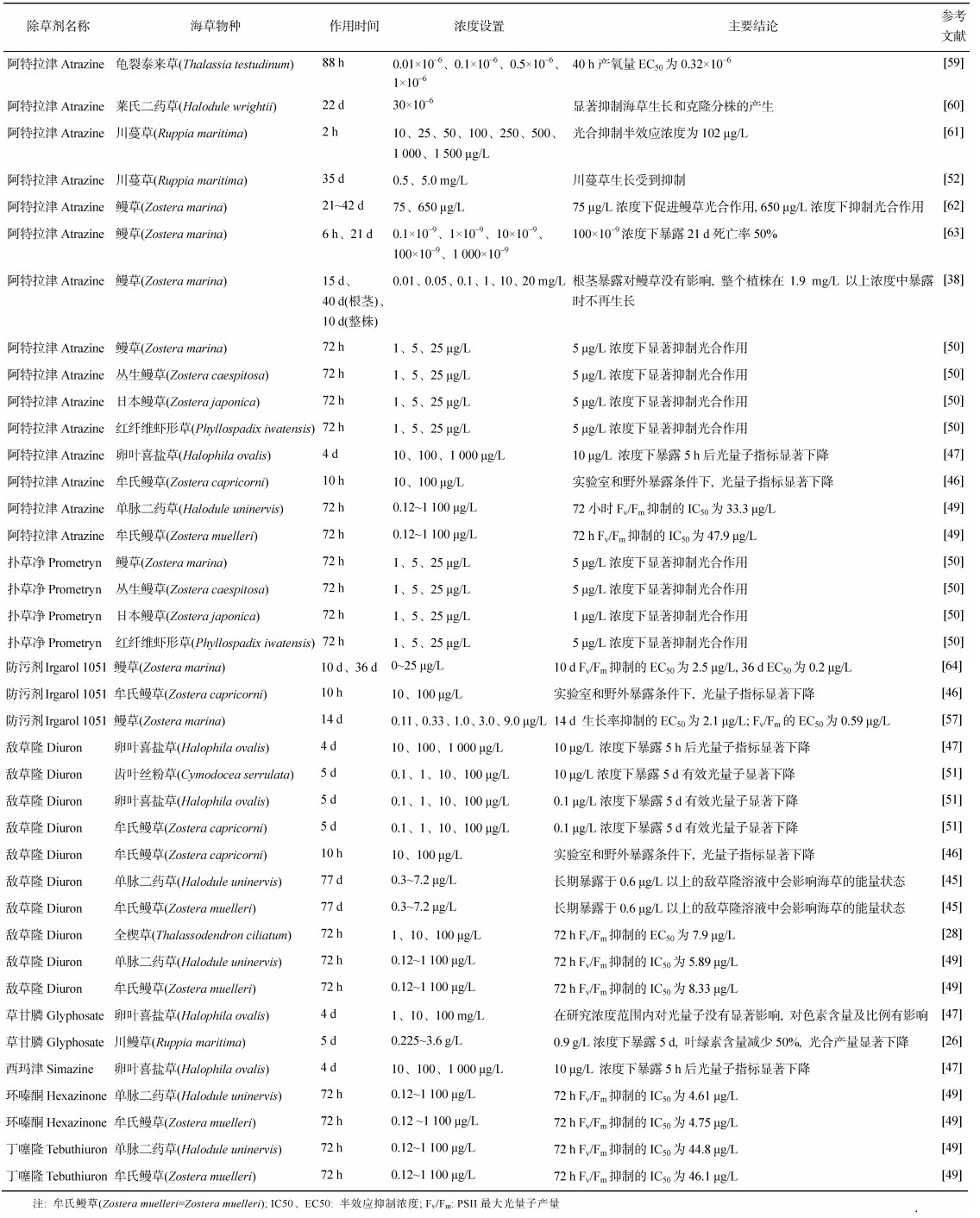
不同的除草剂对海草的毒性差异较大, 与除草剂的作用方式和亲和性有关。Ralph等[47]评价了4种除草剂对卵叶喜盐草(Halophila ovalis)光合作用的毒性, 大小依次为: 敌草隆 > 阿特拉津 > 西玛津 > 草甘膦, 草甘膦由于并不直接作用于海草的光合电子转运过程, 短时间暴露不会对海草的光合能力产生显著影响, 因此毒性作用最小。由于对作用位点的亲和性不同, 具有同种作用方式的除草剂毒性效应也有大小之分。Wilkinson等[48]研究发现10种PSⅡ型除草剂对卵叶喜盐草光合活性的半效应抑制浓度具有较大差异, 其中敌草隆的毒性最强。不同的研究发现, 3种PSⅡ型除草剂对牟氏鳗草(Zostera capricorni)的光合作用毒性大小依次为Irgarol > 敌草隆 > 阿特拉津[46], Irgarol对鳗草的毒性显著高于敌草隆[22], 敌草隆对单脉二药草(Halodule uninervis)的毒性大于阿特拉津[49], 表明以上除草剂其相对毒性大小在不同海草中基本一致。
2.2 不同的海草对同一种除草剂耐受程度不同不同的海草对同一种除草剂的敏感性和耐受程度不同, 与海草的大小、结构、生理状态等密切相关。在0.1 μg/L浓度下敌草隆溶液中暴露5 d后, 齿叶丝粉草(Cymodocea serrulata)未受到显著影响, 而卵叶喜盐草和牟氏鳗草的有效光量子产量却显著降低[50]。不仅在短期急性胁迫中会表现出这一特点, 长期慢性胁迫亦是如此。在敌草隆对牟氏鳗草和单脉二药草的毒性胁迫实验中, 经过11周的长期暴露之后, 牟氏鳗草对敌草隆表现出更强的耐受作用[45]。个体小的海草种类往往对除草剂更为敏感。在同样的暴露时间下, 1 μg/L扑草净即会显著抑制个体较小的日本鳗草(Zostera japonica)的光合作用, 而个体较大的鳗草、丛生鳗草(Zostera caespitosa)、红纤维虾形草(Phyllospadix iwatensis)在5 μg/L浓度下才会表现出显著的抑制作用[51]。
2.3 多种除草剂混合对海草的胁迫作用如前所述, 在海草床中常检测出多种除草剂残留并存[15, 16, 42], Diepens等[14]研究发现, 经过96 h的短暂暴露, 阿特拉津等4种除草剂混合物即对诺氏鳗草(Zostera noltei)产生了亚致死效应, 因此探究多种除草剂混合对海草的胁迫作用更加具有现实意义。
由于混合物中除草剂的种类和浓度各不相同, 多种除草剂混合会对海草表现出协同(Synergistic)、加性(Additive)或拮抗(Antagonistic)效应[22, 28]。将鳗草暴露于Irgarol 1051和敌草隆混合物之中, 与单一除草剂暴露相比, 鳗草的光合效率和生长均无显著差异, 这可能由于两种除草剂因竞争相同的作用位点而表现出拮抗效应[22]。Nielsen等[17]探究了草甘膦、灭草松(Bentazone)和MCPA(一种人工合成的生长素激素)混合物对鳗草的影响, 结果发现鳗草经过低浓度的除草剂混合物处理后, 植株相对生长率、叶绿素a与叶绿素b比例、RNA-DNA比例都下降了近50%, 通过CA(concentration addition)模型进一步计算推测, 低浓度除草剂混合物对鳗草具有协同作用, 而高浓度除草剂混合物对鳗草具有拮抗作用。
在沿海环境中, 由于除草剂降解和海水稀释作用, 除草剂的残留浓度往往处于较低水平, 而低浓度的除草剂混合物对海草常表现为协同或加性作用, Wilkinson等[48]评价了阿特拉津与敌草隆的混合物、10种PSII型除草剂的混合物对卵叶喜盐草的影响, 发现2种混合物对海草均表现为加性效应。低浓度除草剂混合物的长期胁迫, 可能会对海草床产生潜在危害[35-36]。Kennedy等[36]通过对大堡礁附近海域除草剂残留的长期监测与评估, 发现除草剂混合物浓度已经达到能够抑制海草光合作用的阈值范围。因此加强对除草剂混合物的长期监测和风险评价, 有助于为海草资源保护提供更有效的管理策略。
3 除草剂与其他因素联合对海草的胁迫作用除草剂对海草的毒性不仅会受除草剂性质、海草自身状态的影响, 还会因环境条件的改变而不同, 例如培养在无机碳源中的川蔓草(Ruppia maritima)相比在有机碳源中培养, 对除草剂阿特拉津更加敏感, 生长抑制作用更明显[52]。其他如高温、光照、重金属等因素联合作用于海草会比除草剂单一因素产生更大的胁迫作用, 多种压力对海草床的联合作用不容忽视。
3.1 除草剂与高温联合胁迫沿海地区除草剂的残留浓度往往在夏季达到高峰[41, 53-54]。因此, 除草剂很可能会与夏季高温联合共同对海草产生胁迫作用。Negri等[55]发现暴露在除草剂下会使珊瑚在面对高温压力时更加脆弱。海草也是如此, Wilkinson等[54]研究表明高温与除草剂联合对海草引起的负面效应要大于单一因素的影响, 暴露在高温之下的卵叶喜盐草对除草剂敌草隆的胁迫更具敏感性。相较于热带、亚热带海草, 温带海草具有更低的适温范围[56], 因此高温和除草剂的联合胁迫可能会给温带海草带来更大的影响。Gao等[53]通过7 d的暴露实验发现高温和除草剂阿特拉津对鳗草的联合作用比单一因素产生的危害更大, 当温度高于30 ℃时, 施加阿特拉津进一步抑制了鳗草的光合效率和叶片生长率。
3.2 除草剂与光照联合胁迫海平面上升、水体浊度增加和附生植物的生长均会导致海草获得的光照减少, 光照限制和除草剂暴露对植物能量代谢的影响非常相似, 两者联合作用可能会对海草能量的生产和储备产生更极端的影响[45, 49]。Mochida等[57]通过代谢组学分析发现除草剂暴露处理组和海草遮光处理组两者代谢物水平的变化高度一致, 均表现为蔗糖水平降低, 氨基酸(如谷氨酰胺、甘氨酸和亮氨酸)和肌醇水平增加。光照过强也可能会增加海草对除草剂的敏感性, 将卵叶喜盐草暴露于不同的敌草隆浓度和辐照度组合中24 h, 发现在高辐照度下造成了海草的光氧化应激反应, 通过IA模型进一步分析发现辐照度会与敌草隆以加性(additive)或亚加性(sub-additive)的方式影响海草PSII系统[58]。
3.3 除草剂与重金属联合胁迫由于人类活动的影响, 大量重金属元素已经由陆地输入海洋[65], 重金属元素可以在海草体内富集, 达到一定浓度之后产生与除草剂胁迫相似的毒性效应, 对海草床生态系统产生影响[66-68]。Espel等[34]研究发现, 冬季海草根状茎中的淀粉含量与环境中除草剂和重金属的含量呈负相关。Macinnis-Ng等[69]曾使用重金属铜和除草剂Irgarol 1051对牟氏鳗草进行原位脉冲暴露实验, 结果发现海草在两种胁迫因子中暴露的先后顺序不同, 产出的毒性效用也明显不同, 先暴露于铜溶液后暴露于除草剂溶液中的海草光合系统损伤更为严重。
4 监测指标的发展除草剂对海草的胁迫研究相较于其他水生植物起步较晚。随着植物生理学、生态毒理学和现代组学技术的发展, 毒性胁迫相关监测指标也在随之发展。20世纪80—90年代, 光合产氧量、光合/呼吸作用比率、死亡率、生长率最早被用于除草剂对海草等大型水生维管植物的毒性胁迫研究[59, 62]。Delistraty等[63]也曾通过测定腺嘌呤核苷酸含量来反映鳗草在除草剂胁迫下的代谢状态。随后, 光合色素含量及比例、植株特定生长率陆续在除草剂胁迫研究中得到应用[14, 38, 45, 57]。
2000年左右, 叶绿素荧光技术被广泛应用于除草剂对海草的毒性效应研究。叶绿素荧光参数可以用来指示海草电子传递效率的变化, 作为揭示海草光合作用受除草剂胁迫程度的一种重要监测指标。Scarlett等[20]利用叶绿素荧光技术评价了除草剂Irgarol 1051对鳗草光合作用的影响, 当Irgarol 1051浓度大于0.18 μg/L时, 鳗草的光合效率显著降低, 10 d的EC50值为2.5 μg/L, 36 d的EC50值为0.2 μg/L。相比于监测植物的生长率、死亡率和光合色素含量及比例, 叶绿素荧光技术具有快速、灵敏、无损伤的特点, 使研究更加多样、高效并具有可比性[70-71]。Wilkinson等[48]通过叶绿素荧光技术同时评价了10种除草剂对海草的急性毒性影响, Flores等[49]通过叶绿素荧光参数的变化发现海草的光合系统对PSII型除草剂(如敌草隆、阿特拉津等)的敏感性要高于珊瑚和热带微藻。叶绿素荧光成像系统(Imaging-PAM)在分析除草剂的分布和毒害作用方面也具有良好的应用前景, Wilkinson等[58]利用叶绿素荧光成像系统获得叶片的荧光图像, 发现除草剂敌草隆均匀地作用于海草的整个叶片表面, 更加直观地表现出除草剂的毒性胁迫特点。
近年来, 更多的监测指标被用于表征除草剂对海草的胁迫机理, 尤其是组学技术的应用, 为胁迫机理的阐释提供了更加精准全面的工具。Negri等[45]通过监测海草叶片的碳氮比、δ13C含量和植株根茎中淀粉含量等生化指标, 证明长期暴露于低浓度除草剂会降低海草的固碳水平和能量储备。Gao等[72]将鳗草暴露于10 μg/L的阿特拉津溶液中30 d后, 通过非靶向代谢组学分析发现鳗草的碳水化合物及三羧酸循环中间产物浓度降低, 而γ-氨基丁酸(GABA)和1-氨基环丙烷-1-羧酸(ACC)含量升高, 表明阿特拉津影响了鳗草的能量供应和碳氮代谢。将叶绿素荧光技术与现代组学技术相结合可以更加灵敏、全面地阐释除草剂对海草的胁迫机理。Mochida等[57]通过叶绿素荧光、代谢组学、生化和超微结构分析发现, 鳗草暴露于除草剂Irgarol 1051中, 碳水化合物合成受到抑制, 其会利用自噬蛋白降解过程中产生的能量来补偿糖源性代谢能量的损失。此外, RNA-DNA比例[17]、酶活性[14, 25]等指标也是除草剂胁迫研究中非常敏感的监测指标。
5 存在的问题与展望1) 我国是农业大国, 除草剂用量巨大, 但目前对除草剂残留的环境监测主要局限于陆地、淡水区域, 沿海地区相对薄弱。应对我国重点海草床生态系统中的除草剂残留情况进行长期监测并进行生态风险评估, 包括表层海水、海草组织和沉积物等, 从而为海草床的保护提供更有效的管理策略。在加大监测力度的同时, 也要注意科学生产、管理和使用除草剂, 从源头上减少除草剂的残留, 改善近岸海域水质。
2) 随着植物耐药性的出现以及环境保护要求的提高, 科研人员研发出了一些更加低毒、高效的新型除草剂。应加强对新型除草剂研究力度, 重点评估其对于我国沿海海草优势种的毒性效应, 查明不同类型除草剂对不同种类海草的毒害阈值, 充分评价新型除草剂对海草床生态系统的毒性风险。此外, Macinnis-Ng等[46]曾通过比较发现实验室实验可能高估了除草剂对海草的持续影响, 因此也要加强除草剂对海草的原位暴露毒性研究, 从而为除草剂的实际应用提供参考。
3) 当前的研究主要集中于除草剂对海草成株的影响, 而对海草其他生活史阶段的研究相对较少, 仅Gao等研究过除草剂阿特拉津对鳗草有性繁殖[72]和幼苗生长[73]的影响。除草剂使用的高峰期恰好对应着海草种苗生长的关键阶段, 除草剂胁迫是否会对海草的有性繁殖、种子萌发和幼苗生长产生危害, 是否会影响海草有性繁殖和无性繁殖的分配比例, 从而影响海草种群的补充, 还有待于进一步的研究。
4) 在全球气候变化、环境污染物种类繁多的背景之下, 海草床生态系统正面临着多种压力的胁迫[4, 74-75], 除了高温、光照、重金属等因素之外, 除草剂还可能会与硫化物[76]、石油[77]、海洋酸化[78]、富营养化[19]等因素共同作用于海草, 未来需要有更多的研究来量化这些复杂的相互作用, 进一步深入分析对海草的联合效应以及海草床的抵抗和恢复能力。
| [1] |
SHORT F, CARRUTHERS T, DENNISON W, et al. Global seagrass distribution and diversity: A bioregional model[J]. Journal of Experimental Marine Biology & Ecology, 2007, 350(1/2): 3-20. |
| [2] |
MCKENZIE L J, NORDLUND L M, JONES B L, et al. The global distribution of seagrass meadows[J]. Environmental Research Letters, 2020, 15(7): 074041. DOI:10.1088/1748-9326/ab7d06 |
| [3] |
郑凤英, 邱广龙, 范航清, 等. 中国海草的多样性、分布及保护[J]. 生物多样性, 2013, 21(5): 517-526. ZHENG Fengying, QIU Guanglong, FAN Hangqing, et al. Diversity, distribution and conservation of Chinese seagrass species[J]. Biodiversity Science, 2013, 21(5): 517-526. |
| [4] |
ORTH R J, CARRUTHERS T J B, DENNISON W C, et al. A global crisis for seagrass ecosystems[J]. Bioscience, 2006, 56(12): 987-996. DOI:10.1641/0006-3568(2006)56[987:AGCFSE]2.0.CO;2 |
| [5] |
UNSWORTH R K F, NORDLUND L M, CULLENUNSWORTH L C. Seagrass meadows support global fisheries production[J]. Conservation Letters, 2019, 12(1): e12566. DOI:10.1111/conl.12566 |
| [6] |
FOURQUREAN J W, DUARTE C M, KENNEDY H, et al. Seagrass ecosystems as a globally significant carbon stock[J]. Nature Geoscience, 2012, 5(7): 505-509. DOI:10.1038/ngeo1477 |
| [7] |
LAMB J B, VAN DE WATER J A, BOURNE D G, et al. Seagrass ecosystems reduce exposure to bacterial pathogens of humans, fishes, and invertebrates[J]. Science, 2017, 355(6326): 731-733. DOI:10.1126/science.aal1956 |
| [8] |
WAYCOTT M, DUARTE C M, CARRUTHERS T J, et al. Accelerating loss of seagrasses across the globe threatens coastal ecosystems[J]. Proceedings of the National Academy of Sciences of the United States of America, 2009, 106(30): 12377-12381. DOI:10.1073/pnas.0905620106 |
| [9] |
UNSWORTH RKF, MCKENZIE LJ, COLLIER CJ, et al. Global challenges for seagrass conservation[J]. Ambio, 2019, 48(8): 801-815. DOI:10.1007/s13280-018-1115-y |
| [10] |
XU S C, XU S, ZHOU Y, et al. Sonar and in situ surveys of eelgrass distribution, reproductive effort, and sexual recruitment contribution in a eutrophic bay with intensive human activities: Implication for seagrass conservation[J]. Marine Pollution Bulletin, 2020, 161(Pt A): 111706. |
| [11] |
XU S C, QIAO Y, XU S, et al. Diversity, distribution and conservation of seagrass in coastal waters of the Liaodong Peninsula, North Yellow Sea, northern China: Implications for seagrass conservation[J]. Marine Pollution Bulletin, 2021, 167: 112261. DOI:10.1016/j.marpolbul.2021.112261 |
| [12] |
XU S C, XU S, ZHOU Y, et al. Long-term changes in the unique and largest seagrass meadows in the Bohai Sea (China) using satellite (1974–2019) and sonar data: Implication for conservation and restoration[J]. Remote Sensing, 2021, 13(5): 856. DOI:10.3390/rs13050856 |
| [13] |
SHORT F T, POLIDORO B, LIVINGSTONE S R, et al. Extinction risk assessment of the world's seagrass species[J]. Biological Conservation, 2011, 144(7): 1961-1971. DOI:10.1016/j.biocon.2011.04.010 |
| [14] |
DIEPENS N J, BUFFAN-DUBAU E, BUDZINSKI H, et al. Toxicity effects of an environmental realistic herbicide mixture on the seagrass Zostera noltei[J]. Environmental Pollution, 2017, 222: 393-403. DOI:10.1016/j.envpol.2016.12.021 |
| [15] |
HAYNES D, MÜLLER J, CARTER S. Pesticide and herbicide residues in sediments and seagrasses from the Great Barrier Reef world heritage area and Queensland coast[J]. Marine Pollution Bulletin, 2000, 41: 279-287. DOI:10.1016/S0025-326X(00)00097-7 |
| [16] |
MCMAHON K, BENGTSON NASH S, EAGLESHAM G, et al. Herbicide contamination and the potential impact to seagrass meadows in Hervey Bay, Queensland, Australia[J]. Marine Pollution Bulletin, 2005, 51: 325-334. DOI:10.1016/j.marpolbul.2004.10.045 |
| [17] |
NIELSEN LW, DAHLLOF I. Direct and indirect effects of the herbicides Glyphosate, Bentazone and MCPA on eelgrass (Zostera marina)[J]. Aquatic Toxicology, 2007, 82(1): 47-54. DOI:10.1016/j.aquatox.2007.01.004 |
| [18] |
BESTER K. Effects of pesticides on seagrass beds[J]. Helgoland Marine Research, 2000, 54(2/3): 95-98. |
| [19] |
HUGHES R G, POTOUROGLOU M, ZIAUDDIN Z, et al. Seagrass wasting disease: Nitrate enrichment and exposure to a herbicide (Diuron) increases susceptibility of Zostera marina to infection[J]. Marine Pollution Bulletin, 2018, 134: 94-98. DOI:10.1016/j.marpolbul.2017.08.032 |
| [20] |
SCARLETT A, DONKIN P, FILEMAN T W, et al. Occurrence of the antifouling herbicide, Irgarol 1051, within coastal-water seagrasses from Queensland, Australia[J]. Marine Pollution Bulletin, 1999, 38(8): 687-691. DOI:10.1016/S0025-326X(99)00003-X |
| [21] |
JONES R. The ecotoxicological effects of Photosystem Ⅱ herbicides on corals[J]. Marine Pollution Bulletin, 2005, 51: 495-506. DOI:10.1016/j.marpolbul.2005.06.027 |
| [22] |
CHESWORTH J C, DONKIN M E, BROWN M T. The interactive effects of the antifouling herbicides Irgarol 1051 and Diuron on the seagrass Zostera marina (L.)[J]. Aquatic Toxicology, 2004, 66(3): 293-305. DOI:10.1016/j.aquatox.2003.10.002 |
| [23] |
VONK J A, KRAAK M H S. Herbicide exposure and toxicity to aquatic primary producers[J]. Reviews of Environmental Contamination and Toxicology, 2020, 250: 119-171. |
| [24] |
XIE B H, HAN G X, QIAO P Y, et al. Effects of mechanical and chemical control on invasive Spartina alterniflora in the Yellow River Delta, China[J]. PeerJ, 2019, 7: e7655. DOI:10.7717/peerj.7655 |
| [25] |
CARVE M, COGGAN T L, MYERS J H, et al. Impacts on the seagrass, Zostera nigricaulis, from the herbicide Fusilade Forte(R) used in the management of Spartina anglica infestations[J]. Aquatic Toxicology, 2018, 195: 15-23. DOI:10.1016/j.aquatox.2017.11.021 |
| [26] |
KITTLE R P, MCDERMID K J. Glyphosate herbicide toxicity to native Hawaiian macroalgal and seagrass species[J]. Journal of Applied Phycology, 2016, 28(4): 2597-2604. DOI:10.1007/s10811-016-0790-y |
| [27] |
DUKE N C, BELL A M, PEDERSON D K, et al. Herbicides implicated as the cause of severe mangrove dieback in the Mackay region, NE Australia: consequences for marine plant habitats of the GBR World Heritage Area[J]. Marine Pollution Bulletin, 2005, 51: 308-324. DOI:10.1016/j.marpolbul.2004.10.040 |
| [28] |
WAHEDALLY S, MAMBOYA F, LYIMO T, et al. Short-term effects of three herbicides on the maximum quantum yield and electron transport rate of tropical seagrass Thalassodendron ciliatum[J]. Tanzania Journal of Natural and Applied Sciences, 2012, 3: 458-466. |
| [29] |
倪妍, 王毛兰, 赖劲虎, 等. 除草剂对藻类的生态毒理学研究述评[J]. 江西农业大学学报, 2014, 36(3): 536-541. NI Yan, WANG Maolan, LAI Jinhu, et al. A review of the ecological toxicology of herbicide to algae[J]. Acta Agriculturae Universitatis Jiangxiensis, 2014, 36(3): 536-541. DOI:10.13836/j.jjau.2014087 |
| [30] |
ZHANG X M, LIN H Y, SONG X Y, et al. A unique meadow of the marine angiosperm Zostera japonica, covering a large area in the turbid intertidal Yellow River Delta, China[J]. Science of the Total Environment, 2019, 686: 118-130. DOI:10.1016/j.scitotenv.2019.05.320 |
| [31] |
YUE S D, ZHANG X M, XU S C, et al. The super typhoon Lekima (2019) resulted in massive losses in large seagrass (Zostera japonica) meadows, soil organic carbon and nitrogen pools in the intertidal Yellow River Delta, China[J]. Science of the Total Environment, 2021, 793: 148398. |
| [32] |
XU S, XU S C, ZHOU Y, et al. Single beam sonar reveals the distribution of the eelgrass Zostera marina L. and threats from the green tide algae Chaetomorpha linum K. in Swan-Lake lagoon (China)[J]. Marine Pollution Bulletin, 2019, 145: 611-623. DOI:10.1016/j.marpolbul.2019.06.022 |
| [33] |
岳世栋, 徐少春, 张玉, 等. 中国温带海域新发现较大面积(大于50 ha)海草床: Ⅳ烟台沿海海草分布现状及生态特征[J]. 海洋科学, 2021, 45(10): 61-70. YUE Shidong, XU Shaochun, ZHANG Yu, et al. New discovery of larger seagrass beds with area > 50 ha in the temperate waters of China: Ⅳ Distribution status and ecological characteristics of seagrass in the coastal waters of Yantai[J]. Marine Sciences, 2021, 45(10): 61-70. |
| [34] |
ESPEL D, DIEPENS N J, BOUTRON O, et al. Dynamics of the seagrass Zostera noltei in a shallow Mediterranean lagoon exposed to chemical contamination and other stressors[J]. Estuarine, Coastal and Shelf Science, 2019, 222: 1-12. DOI:10.1016/j.ecss.2019.03.019 |
| [35] |
LEWIS S E, SCHAFFELKE B, SHAW M, et al. Assessing the additive risks of PSII herbicide exposure to the Great Barrier Reef[J]. Marine Pollution Bulletin, 2012, 65: 280-291. DOI:10.1016/j.marpolbul.2011.11.009 |
| [36] |
KENNEDY K, SCHROEDER T, SHAW M, et al. Long term monitoring of photosystem II herbicides−correlation with remotely sensed freshwater extent to monitor changes in the quality of water entering the Great Barrier Reef, Australia[J]. Marine Pollution Bulletin, 2012, 65: 292-305. DOI:10.1016/j.marpolbul.2011.10.029 |
| [37] |
TAUCARE G, BIGNERT A, KASERZON S, et al. Detecting long temporal trends of photosystem II herbicides (PSII) in the Great Barrier Reef lagoon[J]. Marine Pollution Bulletin, 2022, 177: 113490. DOI:10.1016/j.marpolbul.2022.113490 |
| [38] |
SCHWARZSCHILD A C, MACINTYRE W G, MOORE K A, et al. Zostera marina L. growth response to atrazine in root-rhizome and whole plant exposure experiments[J]. Journal of Experimental Marine Biology and Ecology, 1994, 183(1): 77-89. DOI:10.1016/0022-0981(94)90158-9 |
| [39] |
任传博, 田秀慧, 张华威, 等. 固相萃取-超高效液相色谱-串联质谱法测定海水中13种三嗪类除草剂残留量[J]. 质谱学报, 2013, 34(6): 353-361. REN Chuanbo, TIAN Xiuhui, ZHANG Huawei, et al. Determination of triazine herbicides in seawater using solid phase extraction-UPLC-MS/MS[J]. Journal of Chinese Mass Spectrometry Society, 2013, 34(6): 353-361. |
| [40] |
张望, 范广宇, 孟祥龙, 等. 海州湾沿岸海水中21种除草剂的分布特征[J]. 江苏农业科学, 2019, 47(23): 289-294. ZHANG Wang, FAN Guangyu, MENG Xianglong, et, al. Distribution characteristics of 21 herbicides in coastal waters of Haizhou Bay[J]. Jiangsu Agricultural Sciences, 2019, 47(23): 289-294. DOI:10.15889/j.issn.1002-1302.2019.23.069 |
| [41] |
徐英江, 刘慧慧, 任传博, 等. 莱州湾海域表层海水中三嗪类除草剂的分布特征[J]. 渔业科学进展, 2014, 35(3): 34-39. XU Yingjiang, LIU Huihui, REN Chuanbo, et al. Distributions of the triazine herbicides in the surface seawater of Laizhou Bay[J]. Progress in Fishery Sciences, 2014, 35(3): 34-39. |
| [42] |
DSIKOWITZKY L, IVETA NGUYEN T M, KONZER L, et al. Occurrence and origin of triazine herbicides in a tropical coastal area in China: A potential ecosystem threat[J]. Estuarine, Coastal and Shelf Science, 2020, 235: 106612. DOI:10.1016/j.ecss.2020.106612 |
| [43] |
高亚平. 桑沟湾除草剂生态风险评估及其对海草的生态毒理作用研究[D]. 青岛: 中国科学院大学(中国科学院海洋研究所), 2018. GAO Yaping. Ecological risk assessment of herbicide in Sanggou Bay and the herbicide ecotoxicity on seagrass[D]. Qingdao: University of Chinese Academy of Sciences (Institute of Oceanology, CAS), 2018. |
| [44] |
TOMASKO D, ALDERSON M, BURNES R, et al. The effects of Hurricane Irma on seagrass meadows in previously eutrophic estuaries in Southwest Florida(USA)[J]. Marine Pollution Bulletin, 2020, 156: 111247. DOI:10.1016/j.marpolbul.2020.111247 |
| [45] |
NEGRI A P, FLORES F, MERCURIO P, et al. Lethal and sub-lethal chronic effects of the herbicide diuron on seagrass[J]. Aquatic Toxicology, 2015, 165: 73-83. DOI:10.1016/j.aquatox.2015.05.007 |
| [46] |
MACINNIS-NG C M O, RALPH P J. Short-term response and recovery of Zostera capricorni photosynthesis after herbicide exposure[J]. Aquatic Botany, 2003, 76(1): 1-15. DOI:10.1016/S0304-3770(03)00014-7 |
| [47] |
RALPH P J. Herbicide toxicity of Halophila ovalis assessed by chlorophyll a fluorescence[J]. Aquatic Botany, 2000, 66(2): 141-152. DOI:10.1016/S0304-3770(99)00024-8 |
| [48] |
WILKINSON A D, COLLIER C J, FLORES F, et al. Acute and additive toxicity of ten photosystem-II herbicides to seagrass[J]. Scientific Reports, 2015, 5: 17443. DOI:10.1038/srep17443 |
| [49] |
FLORES F, COLLIER C J, MERCURIO P, et al. Phytotoxicity of four photosystem II herbicides to tropical seagrasses[J]. PLoS One, 2013, 8(9): e75798. DOI:10.1371/journal.pone.0075798 |
| [50] |
HAYNES D, RALPH P, PRANGE J, et al. The impact of the herbicide diuron on photosynthesis in three species of tropical seagrass[J]. Marine Pollution Bulletin, 2000, 41: 288-293. DOI:10.1016/S0025-326X(00)00127-2 |
| [51] |
高亚平, 蒋增杰, 杜美荣, 等. 除草剂扑草净和阿特拉津对海草与大型藻类的毒性比较[J]. 水生生物学报, 2017, 41(4): 930-4. GAO Yaping, JIANG Zengjie, DU Meirong, et al. Comparison of the herbicide atrazine and prometryn's toxicity on seagrass and seaweed[J]. Acta Hydrobiologica Sinica, 2017, 41(4): 930-4. |
| [52] |
JOHNSON J R, BIRD K T. The Effects of the herbicide atrazine on Ruppia maritima L. growing in autotrophic versus heterotrophic cultures[J]. Botanica Marina, 1995, 38: 307-312. |
| [53] |
GAO Y P, FANG J G, DU M R, et al. Response of the eelgrass (Zostera marina L.) to the combined effects of high temperatures and the herbicide, atrazine[J]. Aquatic Botany, 2017, 142: 41-47. DOI:10.1016/j.aquabot.2017.06.005 |
| [54] |
WILKINSON A D, COLLIER C J, FLORES F, et al. Combined effects of temperature and the herbicide diuron on Photosystem II activity of the tropical seagrass Halophila ovalis[J]. Scientific Reports, 2017, 7: 45404. DOI:10.1038/srep45404 |
| [55] |
NEGRI A P, FLORES F, RÖTHIG T, et al. Herbicides increase the vulnerability of corals to rising sea surface temperature[J]. Limnology and Oceanography, 2011, 56(2): 471-485. DOI:10.4319/lo.2011.56.2.0471 |
| [56] |
LEE K-S, PARK S R, KIM Y K. Effects of irradiance, temperature, and nutrients on growth dynamics of seagrasses: A review[J]. Journal of Experimental Marine Biology and Ecology, 2007, 350: 144-75. DOI:10.1016/j.jembe.2007.06.016 |
| [57] |
MOCHIDA K, HANO T, ONDUKA T, et al. Physiological responses of eelgrass(Zostera marina)to ambient stresses such as herbicide, insufficient light, and high water temperature[J]. Aquatic Toxicology, 2019, 208: 20-28. DOI:10.1016/j.aquatox.2018.12.018 |
| [58] |
WILKINSON A D, COLLIER C J, FLORES F, et al. A miniature bioassay for testing the acute phytotoxicity of photosystem II herbicides on seagrass[J]. PLoS One, 2015, 10(2): e0117541. DOI:10.1371/journal.pone.0117541 |
| [59] |
WALSH G E, HANSEN D L, LAWRENCE D A. A flow-through system for exposure of seagrass to pollutants[J]. Marine Environmental Research, 1982, 7(1): 1-11. DOI:10.1016/0141-1136(82)90047-2 |
| [60] |
MITCHELL C A. Growth of Halodule wrightii in culture and the effects of cropping, light, salinity and atrazine[J]. Aquatic Botany, 1987, 28(1): 25-37. DOI:10.1016/0304-3770(87)90054-4 |
| [61] |
JONES T W, WINCHELL L. Uptake and photosynthetic inhibition by atrazine and its degradation products on four species of submerged vascular plants[J]. Journal of Environmental Quality, 1984, 13(2): 243-247. |
| [62] |
CORRELL D L, WU T L. Atrazine toxicity to submersed vascular plants in simulated estuarine microcosms[J]. Aquatic Botany, 1982, 14(2): 151-158. |
| [63] |
DELISTRATY D A, HERSHNER C. Effects of the herbicide atrazine on adenine nucleotide levels in Zostera marina L. (eelgrass)[J]. Aquatic Botany, 1984, 18(4): 353-369. DOI:10.1016/0304-3770(84)90056-1 |
| [64] |
SCARLETT A, DONKIN P, FILEMAN T W, et al. Risk posed by the antifouling agent Irgarol 1051 to the seagrass, Zostera marina[J]. Aquatic Toxicology, 1999, 45: 159-170. DOI:10.1016/S0166-445X(98)00098-8 |
| [65] |
TIAN K, WU Q M, LIU P, et al. Ecological risk assessment of heavy metals in sediments and water from the coastal areas of the Bohai Sea and the Yellow Sea[J]. Environment International, 2020, 136: 105512. DOI:10.1016/j.envint.2020.105512 |
| [66] |
MACINNIS-NG C M, RALPH P J. Towards a more ecologically relevant assessment of the impact of heavy metals on the photosynthesis of the seagrass, Zostera capricorni[J]. Marine Pollution Bulletin, 2002, 45: 100-106. DOI:10.1016/S0025-326X(01)00300-9 |
| [67] |
GU R, LIN H, ZHOU Y, et al. Programmed responses of different life-stages of the seagrass Ruppia sinensis to copper and cadmium exposure[J]. Journal of Hazardous Materials, 2021, 403: 123875. DOI:10.1016/j.jhazmat.2020.123875 |
| [68] |
黄道建, 黄小平. 海草污染生态学研究进展[J]. 海洋湖沼通报, 2007(S1): 182-188. HUANG Daojian, HUANG Xiaoping. Researches on seagrass pollution ecology and their prospects[J]. Transactions Of Oceanology And Limnology, 2007(S1): 182-188. |
| [69] |
MACINNIS-NG C M, RALPH P J. In situ impact of multiple pulses of metal and herbicide on the seagrass, Zostera capricorni[J]. Aquatic Toxicology, 2004, 67(3): 227-237. DOI:10.1016/j.aquatox.2004.01.012 |
| [70] |
张景平, 黄小平. 叶绿素荧光技术在海草生态学研究中的应用[J]. 海洋环境科学, 2009, 28(6): 772-778. ZHANG Jingping, HUANG Xiaoping. Application of chlorophyll fluorescence techniques in sea-grass ecology research[J]. Marine Environmental Science, 2009, 28(6): 772-778. |
| [71] |
RALPH P J, SMITH R A, MACINNIS-NG C M O, et al. Use of fluorescence-based ecotoxicological bioassays in monitoring toxicants and pollution in aquatic systems: Review[J]. Toxicological & Environmental Chemistry, 2007, 89(4): 589-607. |
| [72] |
GAO Y P, FANG J G, LI W H, et al. Effects of atrazine on the physiology, sexual reproduction, and metabolism of eelgrass (Zostera marina L.)[J]. Aquatic Botany, 2019, 153: 8-14. DOI:10.1016/j.aquabot.2018.10.002 |
| [73] |
GAO Y P, FANG J G, ZHANG J H, et al. The impact of the herbicide atrazine on growth and photosynthesis of seagrass, Zostera marina (L.), seedlings[J]. Marine Pollution Bulletin, 2011, 62(8): 1628-1631. DOI:10.1016/j.marpolbul.2011.06.014 |
| [74] |
SHORT F T, NECKLES H A. The effects of global climate change on seagrasses[J]. Aquatic Botany, 1999, 63: 169-196. DOI:10.1016/S0304-3770(98)00117-X |
| [75] |
TLILI S, MOUNEYRAC C. New challenges of marine ecotoxicology in a global change context[J]. Marine Pollution Bulletin, 2021, 166: 112242. DOI:10.1016/j.marpolbul.2021.112242 |
| [76] |
ZHANG Y, ZHAO P, YUE S D, et al. New insights into physiological effects of anoxia under darkness on the iconic seagrass Zostera marina based on a combined analysis of transcriptomics and metabolomics[J]. Science of the Total Environment, 2021, 768: 144717. DOI:10.1016/j.scitotenv.2020.144717 |
| [77] |
MACINNIS-NG C M, RALPH P J. In situ impact of petrochemicals on the photosynthesis of the seagrass Zostera capricorni[J]. Marine Pollution Bulletin, 2003, 46(11): 1395-1407. DOI:10.1016/S0025-326X(03)00290-X |
| [78] |
RICART A M, WARD M, HILL T M, et al. Coast-wide evidence of low pH amelioration by seagrass ecosystems[J]. Global Chang Biology, 2021, 27(11): 2580-2591. DOI:10.1111/gcb.15594 |