 2024, Vol. 48
文章信息
- SOH TAMEHE Landry, GANNO Sylvestre, 陈祖兴, ROSIÈRE Carlos Alberto. 2024.
- SOH TAMEHE Landry, GANNO Sylvestre, CHEN Zuxing, ROSIÈRE Carlos Alberto. 2024.
- 喀麦隆西南部Mamelles条带状铁建造元素地球化学特征
- Geochemical characteristics of the Mamelles banded iron formations in Southwest Cameroon
- 海洋科学, 48(7): 47-56
- Marine Sciences, 48(7): 47-56.
- http://dx.doi.org/10.11759/hykx20231002001
-
文章历史
- 收稿日期:2023-10-02
- 修回日期:2023-11-24


2. Department of Earth Sciences, University of Yaounde I, 812 Yaounde, Cameroon;
3. 中国科学院海洋研究所, 山东 青岛 266071;
4. Department of Geology, Universidade Federal de Minas Gerais, 31270-901 Belo Horizonte, Minas Gerais, Brazil
2. Department of Earth Sciences, University of Yaounde I, 812 Yaounde, Cameroon;
3. Institute of Oceanology, Chinese Academy of Sciences, Qingdao 266071, China;
4. Department of Geology, Universidade Federal de Minas Gerais, 31270-901 Belo Horizonte, Minas Gerais, Brazil
条带状铁建造(banded iron formation, BIF)是广泛存在于前寒武纪地体中的富铁沉积岩[1]。这类岩石为解读地球环境史、古代海水和大陆的化学性质提供了绝佳的材料[2-3]。BIF的特点是铁氧化物富集层和富含二氧化硅层交替出现[4]。尽管对BIF的研究已经超过一个多世纪, 但对BIF物质来源的认识仍存在争议, 提出的模型通常包括: 1)大陆来源[5-6], 2)热液来源[7-8], 3)大陆-热液混合来源[9]。
在喀麦隆南部, 刚果克拉通西北缘被划分为太古宙Ntem杂岩体和新太古代-古元古代Nyong杂岩体[10-11]。虽然这两个杂岩体都有BIF型铁矿分布, 但是仅Nyong杂岩中BIF(图 1)的岩石学和地球化学特征得到了详细研究[12-18]。Mamelles铁矿床是Nyong杂岩体中研究程度较低的一个铁矿床(图 1), 仅有一项可行性研究揭示了在含铁35%的情况下, 其估计资源量为6.33×10¹⁰ t, 初期年产量为4×10⁶ t[19]。此外, 该矿床位于大西洋海岸以东约20 km处且靠近克里比深海港口(图 1), 这无疑使得它成为一个极具商业价值的铁矿床。然而, Mamelles BIF型铁矿床的成因和沉积环境仍然不清楚。
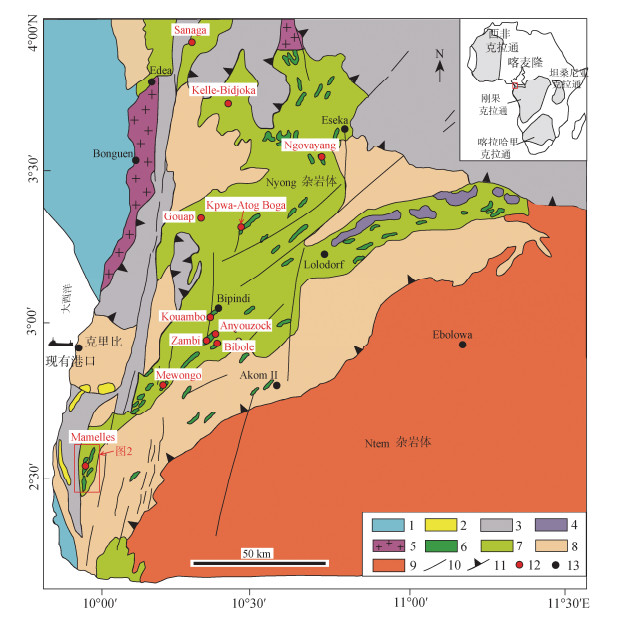 |
| 图 1 刚果克拉通西北部喀麦隆西南部Nyong杂岩体地质简图 Fig. 1 Geological sketch map of the Nyong Complex in southwestern Cameroon, northwestern margin of Congo Craton 注: 1—海岸沉积物; 2—变质正长岩; 3—片麻岩、云母岩、石英岩; 4—Lolodorf-Olama变质正长岩; 5— Bonguen变质花岗闪长岩; 6—石榴子石-磁铁矿石英岩和BIF; 7—含正辉石片麻岩; 8—黑云母普通角闪石片麻岩和英云闪长岩-花岗闪长岩; 9—Ntem杂岩体; 10—断层/剪切带; 11—逆掩断层; 12—BIF铁矿; 13—城市 |
本研究, 我们报道了Mamelles BIF的野外产状、岩石学和全岩地球化学数据, 以限制其成因和沉积环境。进一步评估了热液流体对Mamelles BIF化学沉淀的贡献比例以及BIF沉积过程中海水的氧化还原条件。
1 地质背景Nyong杂岩体由BIF、片麻岩、角闪岩、英云闪长岩-花岗闪长岩套、石英岩、片岩、榴辉岩、蛇纹岩、变质正长岩、变质花岗闪长岩和变质辉长岩组成[11-19]。Nyong杂岩体的火山-沉积序列形成于约2 466~2 422 Ma(U-Pb锆石), 经历了Eburnean-Transamazonian造山运动(约2 080~2 050 Ma; U-Pb锆石)和泛非洲造山运动(约620~500 Ma; U-Pb锆石)时期的变质作用[20-24]。Nyong杂岩体约在2 100~2 000 Ma发生深成岩浆侵入活动, 与约2 050 Ma的紫苏花岗岩形成有关, 并发生高级变质作用[23-24]。2 093(±45)Ma (SHRIMP U-Pb锆石)发生榴辉岩相变质作用[25], 变质压力和温度条件分别为16~25 kbar和800~850 ℃[26]。Nyong杂岩体中的BIF通常与火山岩和沉积岩交互层位, 经历了区域角闪岩-麻粒岩相变质作用[21-22]。这些BIF与伴生岩石之间的接触面通常清晰锐利, 没有不整合的迹象[13-14]。Nyong杂岩体的BIF特征是相对较薄的层状结构(中间带)为特征, 厚度在1至5 km之间变化[15-16]。中间带结构由铁氧化物和石英交替排列的微层(带宽为0.5~3 cm)组成[17-18]。
Mamelles铁矿床位于Nyong杂岩体的最南部(图 1)。该矿床呈近南北向延伸, 全长约15 km, 覆盖面积为7~8 km2(图 2)。目前尚未确定该矿床的地层学特征, 但主要由含角闪石-石榴石片麻岩、辉石角闪岩和BIF组成[27-28]。该矿床的变质沉积岩和变质火山岩经历了绿片岩相到麻粒岩相的变质作用[27]。该矿床的铁矿石主要由马氏体铁矿、针铁矿和石英组成, 少量为磁铁矿、高岭石和埃洛石[28]。
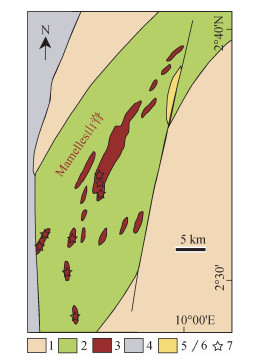 |
| 图 2 Mamelles铁矿床简化地质图 Fig. 2 Simplified geological map of the Mamelles iron ore deposit 注: 1—角闪石-石榴子石片麻岩; 2—角闪岩; 3—BIF; 4—云母片岩; 5—石英岩; 6—断层; 7—样品点 |
在本研究中, 我们从露头岩层中采集了8个代表性的BIF样品(图 2)。这些样品在中国科学院地质与地球物理研究所岩石矿物制备与分析实验室进行了抛光薄片的制备。详细的岩相学观察是在中国矿业大学使用尼康Eclipse E600 Pol偏光显微镜进行的, 该显微镜配备了一台尼康Digital Sight 5MP相机, 并使用“NIS-Elements”图像整合软件进行拍摄。
主量和微量元素分析在加拿大温哥华的ACME实验室完成。岩石样品被粉碎后, 称取约0.5 g粉末样品放入熔炉中, 并加入偏硼酸锂/四硼酸锂和硝酸进行消解。主量元素采用电感耦合等离子体原子发射光谱法(ICP-AES)分析, 微量元素采用电感耦合等离子体质谱法(ICP-MS)测定。主量元素的测量浓度的质量分数准确度介于0.1%~0.04%之间, 微量元素介于0.5~0.1 μg/g之间, 稀土元素为0.5~0.01 μg/g。稀土元素的分析精度在浓度高于10 μg/g时为5%, 在浓度较低时为10%。烧失量(LOI)是在1 000 ℃下点火后通过重量差测定的。
Mamelles BIF的稀土元素利用后太古代澳大利亚页岩(PAAS, 下标SN)[29]进行标准化。BIF的铕(Eu)、铈(Ce)、镧(La)、钆(Gd)、钇(Y)、镨(Pr)异常(δ), 利用标准化的数据, 根据以下公式进行计算[30-31]:
| $\delta \mathrm{Eu}=\mathrm{Eu}_{\mathrm{SN}} /\left(0.67 \times \mathrm{Sm}_{\mathrm{SN}}+0.33 \times \mathrm{Tb}_{\mathrm{SN}}\right), $ | (1) |
| $ \delta \mathrm{Ce}=\mathrm{Ce}_{\mathrm{SN}} /\left(0.5 \times \mathrm{La}_{\mathrm{SN}}+0.5 \times \mathrm{Pr}_{\mathrm{SN}}\right), $ | (2) |
| $\delta \operatorname{Pr}=\operatorname{Pr}_{\mathrm{SN}} /\left(0.5 \times \mathrm{Ce}_{\mathrm{SN}}+0.5 \times \mathrm{Nd}_{\mathrm{SN}}\right), $ | (3) |
| $\delta \mathrm{La}=\mathrm{La}_{\mathrm{SN}} /\left(3 \times \operatorname{Pr}_{\mathrm{SN}}-2 \times \mathrm{Nd}_{\mathrm{SN}}\right), $ | (4) |
| $\delta \mathrm{Gd}=\mathrm{Gd}_{\mathrm{SN}} /\left(0.33 \times \mathrm{Sm}_{\mathrm{SN}}+0.67 \times \mathrm{Tb}_{\mathrm{SN}}\right), $ | (5) |
| $ \delta \mathrm{Y}=2 \times \mathrm{Y}_{\mathrm{SN}} /\left(\mathrm{Dy}_{\mathrm{SN}}+\mathrm{Ho}_{\mathrm{SN}}\right) . $ | (6) |
Mamelles BIF在矿床的中部出露(图 2、3a)。岩石为细粒至中粒, 由富硅层和富铁层交替组成, 厚度分别为1~10 mm和2~16 mm, 条带通常是不连续的(图 3a)。在薄片中, 岩石显示出由石英(约50%)和磁铁矿(约50%)组成的花岗变晶状不等粒微观结构(图 3b)。石英呈半自形至他形, 粒径可达300 µm。晶体通常形成不规则的聚集体, 在富铁层中很少发现单个颗粒(图 3b)。磁铁矿晶体呈他行, 粒径小于1 mm, 形成不连续带(图 3b), 有些晶体变成赤铁矿。
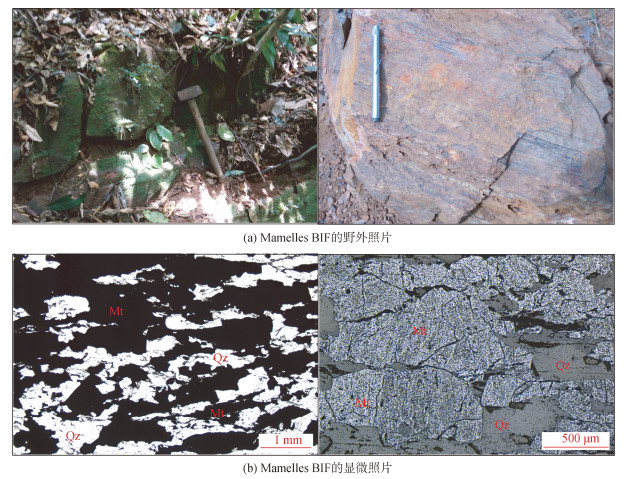 |
| 图 3 Mamelles BIF的野外和显微照片 Fig. 3 Field photographs and microphotographs of the Mamelles BIFs 注: 显微照片为富磁铁矿层与富石英层交替的花岗变晶结构; 反射光。Mt—磁铁矿, Qz—石英 |
Mamelles BIF的主量元素和微量元素组成见表 1和表 2。所研究的BIF主要由Fe2O3和SiO2组成, 质量分数分别为53.59%~59.09%和40.12%~44.62% (表 1)。这些BIF的Al2O3(0.21%~0.42%)、TiO2(0.01%~0.03%)、MgO(< 0.01%~1.20%)和MnO(0.01%~0.12%)的质量分数很低(表 1); 其他主量元素如CaO (< 0.01%~0.01 %)、P2O5(< 0.01~0.06%)、Na2O (< 0.01%~0.02%)、K2O(< 0.01%)和Cr2O3(< 0.01%)的质量分数也非常低。
| 样品 | MBF1 | MBF2 | MBF3 | MBF4 | MBF5 | MBF6 | MBF7 | MBF8 | Mean |
| SiO2 | 41.26 | 44.62 | 42.21 | 43.25 | 41.63 | 40.38 | 41.35 | 40.12 | 41.85 |
| Al2O3 | 0.42 | 0.29 | 0.38 | 0.33 | 0.42 | 0.23 | 0.21 | 0.35 | 0.33 |
| Fe2O3T | 58.22 | 53.59 | 56.81 | 55.81 | 57.51 | 58.12 | 58.08 | 59.09 | 57.15 |
| MnO | 0.02 | 0.01 | 0.02 | 0.02 | 0.02 | 0.12 | 0.08 | 0.09 | 0.05 |
| MgO | < 0.01 | 0.27 | 0.06 | 0.11 | < 0.01 | 1.20 | 0.38 | 0.20 | 0.37 |
| CaO | 0.01 | < 0.01 | < 0.01 | < 0.01 | 0.01 | < 0.01 | < 0.01 | < 0.01 | 0.01 |
| Na2O | < 0.01 | < 0.01 | < 0.01 | < 0.01 | < 0.01 | 0.01 | 0.01 | 0.02 | 0.01 |
| K2O | < 0.01 | < 0.01 | < 0.01 | < 0.01 | < 0.01 | < 0.01 | < 0.01 | < 0.01 | < 0.01 |
| TiO2 | 0.01 | < 0.01 | 0.02 | 0.02 | 0.02 | 0.01 | 0.01 | 0.03 | 0.02 |
| P2O5 | 0.05 | < 0.01 | < 0.01 | < 0.01 | 0.06 | 0.02 | 0.01 | 0.02 | 0.03 |
| Cr2O3 | < 0.002 | < 0.002 | < 0.002 | < 0.002 | < 0.002 | < 0.002 | < 0.002 | < 0.002 | < 0.002 |
| 烧失量 | 0.00 | 1.20 | 0.50 | 0.50 | 0.30 | 1.65 | 0.80 | 0.25 | 0.65 |
| 总质量分数 | 99.99 | 98.78 | 99.50 | 99.54 | 99.67 | 100.09 | 100.13 | 99.91 | 99.70 |
| SiO2 + Fe2O3 | 99.48 | 98.21 | 99.02 | 99.06 | 99.14 | 98.50 | 99.43 | 99.21 | 99.01 |
| 注: MBF为Mamelle BIF, 数字1~8代表样品点, 采样位置见图 2 | |||||||||
| 样品 | MBF1 | MBF2 | MBF3 | MBF4 | MBF5 | MBF6 | MBF7 | MBF8 | 平均值 |
| Ba | 8.00 | 13.00 | 2.00 | 1.00 | 6.00 | 3.00 | 7.00 | 9.00 | 6.00 |
| Ni | < 20 | < 20 | < 20 | < 20 | < 20 | < 20 | < 20 | < 20 | < 20 |
| Co | 1.70 | 0.20 | 0.70 | 1.00 | 1.60 | 0.80 | 1.30 | 0.50 | 1.04 |
| Hf | < 0.1 | 0.10 | < 0.1 | 0.10 | 0.10 | 0.10 | < 0.1 | 0.10 | 0.10 |
| Nb | 0.60 | 0.30 | 0.80 | 0.70 | 1.10 | 0.60 | 0.90 | 0.30 | 0.70 |
| Rb | < 0.1 | < 0.1 | < 0.1 | < 0.1 | < 0.1 | < 0.1 | < 0.1 | < 0.1 | < 0.1 |
| Sr | 1.00 | 3.80 | 1.20 | 0.50 | 0.50 | 1.30 | 0.70 | 2.50 | 1.40 |
| Ta | < 0.1 | < 0.1 | 0.10 | 0.10 | < 0.1 | < 0.1 | 0.10 | 0.10 | 0.10 |
| Th | 0.30 | 1.10 | < 0.2 | < 0.2 | 0.30 | 1.20 | 0.50 | 1.00 | 0.57 |
| U | 0.20 | 0.30 | < 0.1 | < 0.1 | 0.20 | 0.40 | < 0.1 | < 0.1 | 0.23 |
| V | 11.00 | < 8 | < 8 | < 8 | < 8 | 10.00 | 5.00 | < 8 | 11.00 |
| Zr | 2.80 | 5.20 | 2.80 | 2.20 | 4.60 | 3.50 | 2.70 | 6.10 | 3.52 |
| La | 3.50 | 3.76 | 3.12 | 3.80 | 4.50 | 4.20 | 3.96 | 2.80 | 3.74 |
| Ce | 5.58 | 6.10 | 4.83 | 5.90 | 7.40 | 5.50 | 7.40 | 4.15 | 5.96 |
| Pr | 0.80 | 0.88 | 0.63 | 0.85 | 1.05 | 0.76 | 1.05 | 0.54 | 0.84 |
| Nd | 3.35 | 3.90 | 2.67 | 3.80 | 4.35 | 3.20 | 4.35 | 2.35 | 3.61 |
| Sm | 0.55 | 0.70 | 0.47 | 0.65 | 0.98 | 0.52 | 0.98 | 0.40 | 0.67 |
| Eu | 0.32 | 0.39 | 0.20 | 0.35 | 0.65 | 0.26 | 0.65 | 0.18 | 0.38 |
| Gd | 0.50 | 0.65 | 0.37 | 0.67 | 0.89 | 0.47 | 0.89 | 0.34 | 0.62 |
| Tb | 0.09 | 0.10 | 0.07 | 0.11 | 0.12 | 0.08 | 0.12 | 0.06 | 0.10 |
| Dy | 0.41 | 0.51 | 0.38 | 0.52 | 0.58 | 0.37 | 0.58 | 0.35 | 0.48 |
| Y | 2.36 | 3.20 | 2.49 | 3.15 | 3.40 | 2.30 | 3.40 | 2.18 | 2.92 |
| Ho | 0.10 | 0.12 | 0.09 | 0.11 | 0.15 | 0.09 | 0.15 | 0.08 | 0.11 |
| Er | 0.35 | 0.38 | 0.26 | 0.35 | 0.49 | 0.31 | 0.49 | 0.23 | 0.37 |
| Tm | 0.05 | 0.05 | 0.03 | 0.05 | 0.06 | 0.04 | 0.06 | 0.03 | 0.05 |
| Yb | 0.26 | 0.28 | 0.18 | 0.27 | 0.39 | 0.23 | 0.39 | 0.19 | 0.28 |
| Lu | 0.05 | 0.05 | 0.03 | 0.05 | 0.07 | 0.04 | 0.07 | 0.03 | 0.05 |
| ΣREE-Y | 18.27 | 21.07 | 15.82 | 20.63 | 25.08 | 18.37 | 24.54 | 13.91 | 20.17 |
| Y/Ho | 23.60 | 26.67 | 27.67 | 28.64 | 22.67 | 25.56 | 22.67 | 27.25 | 25.85 |
| (Pr/Yb)SN | 0.98 | 1.00 | 1.12 | 1.01 | 0.86 | 1.06 | 0.86 | 0.91 | 0.98 |
| (Sm/Yb)SN | 1.07 | 1.27 | 1.33 | 1.22 | 1.28 | 1.15 | 1.28 | 1.07 | 1.23 |
| δCe | 0.77 | 0.77 | 0.79 | 0.76 | 0.79 | 0.70 | 0.84 | 0.78 | 0.78 |
| δPr | 1.07 | 1.04 | 1.02 | 1.03 | 1.07 | 1.05 | 1.07 | 1.01 | 1.05 |
| δGd | 0.97 | 1.09 | 0.90 | 1.07 | 1.18 | 1.01 | 1.18 | 0.96 | 1.04 |
| δLa | 1.24 | 1.43 | 1.45 | 1.54 | 1.18 | 1.58 | 1.04 | 1.64 | 1.35 |
| δEu | 2.83 | 2.84 | 2.14 | 2.58 | 3.55 | 2.48 | 3.55 | 2.26 | 2.79 |
| δY | 0.93 | 1.03 | 1.07 | 1.05 | 0.91 | 1.00 | 0.91 | 1.04 | 1.00 |
| 注: MBF为Mamelle BIF, 数字1~8代表样品点, 采样位置见图 2 | |||||||||
Mamelle BIF高场强元素, 如锆(Zr)、铪(Hf), 铌(Nb)和钽(Ta), 组成分别为2.20~6.10 μg/g、< 0.1~0.10 μg/g、0.30~1.10 μg/g以及 < 0.1~0.10 μg/g(表 2)。大离子亲石元素钡(Ba)和锶(Sr)的组成分别为1~13 μg/g和0.50~3.80 μg/g(表 2)。所有BIF样品的过渡族元素, 如钒(V)、钴(Co)和镍(Ni)组成分别为 < 8 μg/g、0.20~1.70 μg/g和 < 20 μg/g(表 2)。
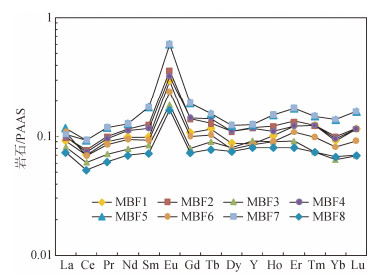
Mamelles BIF样品的稀土元素及钇(REE-Y)范围为15.82~25.08 μg/g(表 2)。当与后太古宙澳大利亚页岩[29](PAAS, 下标SN)进行标准化后, BIF样品的特征是: 相对于重REE((Sm/Yb)SN = 0.45~1.65)), 亏损轻REE((Pr/Yb)SN = 0.86~1.12)(表 2, 图 4); 负Ce异常(δCe = 0.70~0.84; 正La异常(δLa = 1.04~1.58); 负Gd异常(δGd= 0.90~1.18); 正Eu异常(δEu = 2.14~3.355); Y负异常(δY = 0.91~1.07)和亚球粒陨石Y/Ho(17.0~21.9)比值(表 2, 图 4)。
从岩石学上看, Mamelles BIF由富铁带和富硅带交替组成, 这与它们的SiO2和Fe2O3组成占全岩的98%以上(表 1)相一致。所研究的BIF中Al2O3(0.33%)和TiO2(0.02%)的平均质量分数较低, 表明沉积过程中碎屑物质输入的贡献比较小。这一解释与BIF中具有极低的Zr(≤6.1 μg/g)、Hf(≤0.1 μg/g)和REE-Y(平均值: 20.17 μg/g)相一致, 与纯化学沉淀的特征相似[32]。
尽管BIF被认为是纯化学沉积物, 但它们的成分可能受到变质和风化作用的影响[8, 33]。所研究的BIF的烧失量(LOI)值较低, 范围在0.01%至0.80%之间(表 1), 表明其受成岩后期作用的影响有限。因此, 所研究的Mamelles BIF中流体活动性弱的高场强元素(HFSE)和稀土元素(REE)的化学成分可以用来约束它们的物质来源和构造沉积环境。
4.2 Mamelles BIF的物质来源BIF的REE-Y特征已被证明是约束这些化学沉积岩铁来源的有效指标[30-32]。太古宙和古元古代BIF通常显示出正Eu异常, 表明海底火山岩的深海蚀变产生了热液流体[31]。弱或无Eu异常通常与低温热液流体(< 200 ℃)相关, 而强正Eu异常是高温(> 250 ℃)热液流体的特征[34]。所研究的BIF具有正Eu异常, 其在REE趋势图中介于高温和低温热液流体以及南太平洋海水的平均组成之间(图 5a)。它们的REE组成与后大氧化事件(GOE)的古元古代海水特征一致, 如LREE亏损和HREE富集, 亚球体陨石Y/Ho比值, 广泛范围的Gd和La异常, 主要为正值, 以及正Eu异常[31-32](图 4)。
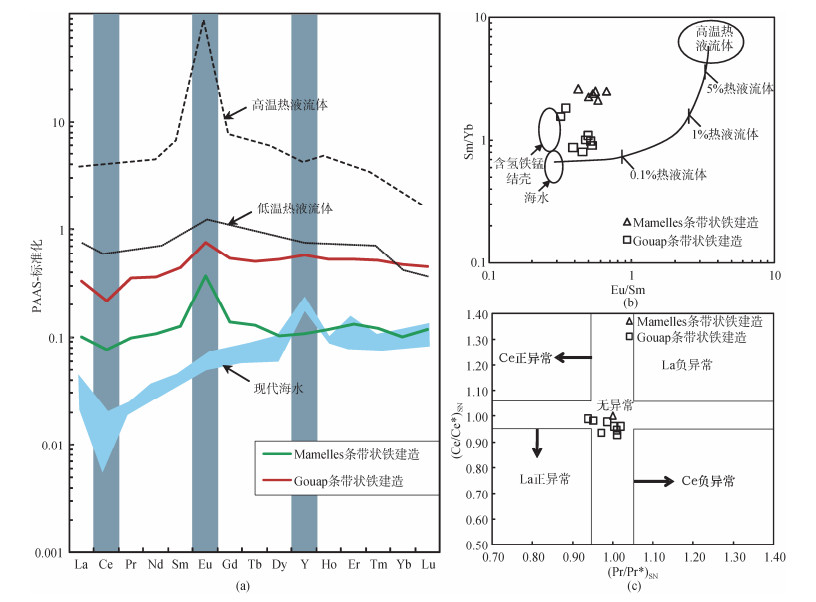
可以使用Sm/Yb与Eu/Sm图解[36]来评估海水与热液流体的比例。如图 5b所示, 大部分Mamelles BIF集中在靠近海水成分的区域, 高温热液流体的贡献比例≤0.1%。所研究的BIF与Nyong杂岩Gouap BIF中观察到的REE-Y特征一致[16](图 5a)。Mamelles BIF在(Ce/Ce*)SN与(Pr/Pr*)SN图上缺乏Ce异常[30], 这与Gouap BIF类似(图 5c)。这表明所研究的BIF是在亚氧至厌氧的海水中沉积的。因此, 这些特征与Nyong杂岩BIF的晚古元古代(2.1 Ga)区域环境条件一致[14]。
4.3 Mamelles BIF的沉积环境根据岩石地层组合和构造环境, 铁建造被分为Algoma型和Superior型BIF[37]。Superior型BIF通常与碳酸盐和硅质碎屑沉积物相关联, 在地层中仅有有限的火山岩贡献, 并且沉积于广阔的大陆边缘[37]。相比之下, Algoma型BIF通常与双峰式火山岩、灰岩和硅质碎屑沉积物有关, 并且沉积于小型的构造活跃盆地, 靠近火山中心, 形成于弧-裂谷相关的环境中[2, 37]。
根据野外地质调查, Mamelles BIF与含角闪石-石榴石片麻岩、辉石角闪岩相关(图 2)。这种变质火山-沉积序列类似于Algoma型BIF, 由BIF与火山岩(角闪岩)和薄的硅质碎屑沉积物(片麻岩)交互堆积而成[27], 沉积于靠近海底热液活动的深水环境中[2, 37]。Mamelles BIF的δEu比值范围为2.14~3.55, 平均值为2.79(表 2), 与Algoma型BIF的高值(> 1.25)相似[38]。REE组成结合变质火山-沉积序列地球化学特征[32](表 2), 表明Mamelles BIF是在靠近陆地的深水、海底火山环境中沉积的(图 6)。这一结果与Nyong杂岩BIF的区域构造背景一致[14, 17]。
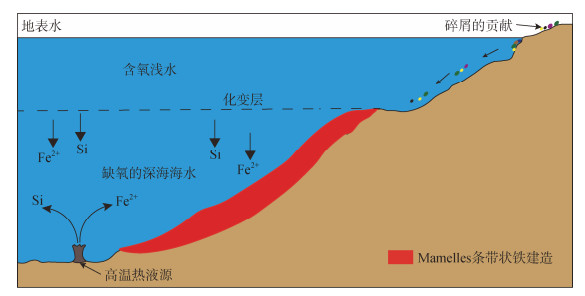 |
| 图 6 Mamelles BIF沉积示意图(不按比例) Fig. 6 Sketch depositional model of the Mamelles BIFs (not to scale) |
对喀麦隆南部刚果板块西北边缘Nyong杂岩的Mamelles BIF进行了野外调查, 结合全岩地球化学数据, 为这些化学沉积岩的物质来源和沉积构造环境提供了约束条件。主要结论如下:
1) Mamelles BIF与角闪岩和片麻岩交互层位; 由富硅(石英)层和富铁(磁铁矿)层交替组成, 条带通常是不连续的。
2) Mamelles BIF主要由SiO2和Fe2O3组成(质量分数 > 98%), Al2O3、TiO2的质量分数较低, 分别为大约0.33%和大约0.02%; 微量元素Zr、Hf以及REE-Y组成分别≤6.1 μg/g、≤0.1 μg/g以及大约20.17 μg/g, 这些地球化学特征表明其是由海水和高温热液流体的混合作用形成, 碎屑物质输入不明显。
3) Mamelles BIF沉积于含Nyong杂岩的海底火山弧的大陆边缘环境。
| [1] |
HAGEMANN S G, ANGERER T, DUURING P, et al. BIF-hosted iron mineral system: A review[J]. Ore Geology Reviews, 2016, 76: 317-359. DOI:10.1016/j.oregeorev.2015.11.004 |
| [2] |
BEKKER A, SLACK J F, PLANAVSKY N, et al. Iron formation: the sedimentary product of a complex interplay among mantle, tectonic, oceanic and biospheric processes[J]. Economic Geology, 2010, 105: 467-508. DOI:10.2113/gsecongeo.105.3.467 |
| [3] |
杨秀清, 毛景文, 张作衡, 等. 条带状铁建造: 特征、成因及其对地球环境的制约[J]. 矿床地质, 2020, 39(4): 697-727. YANG Xiuqing, MAO Jingwen, ZHANG Zuoheng, et al. Banded iron formations: Their characteristics, genesis and implications for ancient Earth's environment[J]. Mineral Deposits, 39(4): 697-727. |
| [4] |
TRENDALL A F. The significance of iron-formation in the Precambrian stratigraphic record[J]. Special Publication of the International Association of Sedimentologists, 2002, 33: 33-66. |
| [5] |
HOLLAND H D. The chemical evolution of the atmosphere and oceans[M]. Princeton, New Jersey: Princeton University Press, 1984: 582.
|
| [6] |
ALIBERT C, MCCULLOCH M T. Rare earth element and neodymium isotopic compositions of the banded iron-formations and associated shales from the Hamersley, Western Australia[J]. Geochimica et Cosmochimica Acta, 1993, 57(1): 187-204. DOI:10.1016/0016-7037(93)90478-F |
| [7] |
SIMONSON B M. Sedimentological constraints on the origins of Precambrian iron-formations[J]. Geological Society of America Bulletin, 1985, 96(2): 244-252. DOI:10.1130/0016-7606(1985)96<244:SCOTOO>2.0.CO;2 |
| [8] |
DYMEK R F, KLEIN C. Chemistry, petrology and origin of banded iron-formation lithologies from the 3800 Ma Isua supracrustal belt, West Greenland[J]. Precambrian Research, 1988, 39(4): 247-302. DOI:10.1016/0301-9268(88)90022-8 |
| [9] |
HAMADE T, KONHAUSER K O, RAISWELL R, et al. Using Ge/Si ratios to decouple iron and silica fluxes in Precambrian banded iron formations[J]. Geology, 2003, 31(1): 35-38. DOI:10.1130/0091-7613(2003)031<0035:UGSRTD>2.0.CO;2 |
| [10] |
NDIME E N, GANNO S, SOH TAMEHE L, et al. Petrography, lithostratigraphy and major element geochemistry of Mesoarchean metamorphosed banded iron formation-hosted Nkout iron ore deposit, north western Congo craton, Central West Africa[J]. Journal of African Earth Sciences, 2018, 148: 80-98. DOI:10.1016/j.jafrearsci.2018.06.007 |
| [11] |
SOH TAMEHE L, WEI C T, GANNO S, et al. Geology of the Gouap iron deposit, Congo craton, southern Cameroon: Implications for iron ore exploration[J]. Ore Geology Reviews, 2019, 107: 1097-1128. DOI:10.1016/j.oregeorev.2019.03.034 |
| [12] |
GANNO S, NJIOSSEU TANKO E L, KOUANKAP NONO G D, et al. A mixed seawater and hydrothermal origin of superior-type banded iron formation (BIF)-hosted Kouambo iron deposit, Palaeoproterozoic Nyong series, Southwestern Cameroon: Constraints from petrography and geochemistry[J]. Ore Geology Reviews, 2017, 80: 860-875. DOI:10.1016/j.oregeorev.2016.08.021 |
| [13] |
MOUDIOH C, SOH TAMEHE L, GANNO S, et al. Tectonic environment of the banded iron formations from the Bipindi greenstone belt, Ntem Complex, southwestern Cameroon: Constraint from the petrographical and geochemical studies of the metamorphic wallrocks[J]. Journal of African Earth Sciences, 2020, 171: 103971. DOI:10.1016/j.jafrearsci.2020.103971 |
| [14] |
DEASSOU SEZINE E, SOH TAMEHE L, GANNO S, et al. Geochronological and geochemical constraints for the metavolcanosedimentary succession of the Nyong Complex, northwestern margin of the Congo craton: Implications for depositional age and tectonic setting of associated banded iron formations[J]. Precambrian Research, 2022, 383: 106910. DOI:10.1016/j.precamres.2022.106910 |
| [15] |
SOH TAMEHE L, TANKWA M N, WEI C T, et al. Geology and geochemical constrains on the origin and depositional setting of Kpwa-Atog Boga banded iron formations (BIFs), northwestern Congo craton, southern Cameroon[J]. Ore Geology Reviews, 2018, 95: 620-638. DOI:10.1016/j.oregeorev.2018.03.017 |
| [16] |
TAMEHE L S, WEI C T, GANNO S, et al. Depositional age and tectonic environment of the Gouap banded iron formations from the Nyong Group, SW Cameroon: Insights from isotopic, geochemical and geochronological studies of drillcore samples[J]. Geoscience Frontiers, 2021, 12(2): 549-572. DOI:10.1016/j.gsf.2020.07.009 |
| [17] |
TAMEHE L S, WEI C T, GANNO S, et al. Provenance of metasiliciclastic rocks at the East Gabonian Block: Implications for deposition of BIFs and crustal evolution in southwestern Cameroon[J]. Precambrian Research, 2022, 376: 106677. DOI:10.1016/j.precamres.2022.106677 |
| [18] |
SOH TAMEHE L, LI H, GANNO S, et al. Insight into the origin of iron ore based on elemental contents of magnetite and whole-rock geochemistry: a case of the Bipindi Banded Iron Formations, Nyong Complex, SW Cameroon[J]. Journal of Earth Science, 2024, 35(1): 16-28. DOI:10.1007/s12583-022-1622-4 |
| [19] |
Ministry of Mines, Industry and Technological Development. Cameroon exploration industry: Opportunities and perspectives[R]. PDAC Report, 2014: 16.
|
| [20] |
DJOUKOUO SOH A P, GANNO S, ZHANG L C, et al. Geochemical and geochronological constraints on the origin of the Bibole banded iron formations, northwestern Congo Craton, Cameroon: Implications for their depositional age and tectonic environment[J]. Geological Magazine, 2021, 158: 2245-2263. DOI:10.1017/S0016756821000765 |
| [21] |
NGA ESSOMBA T P, GANNO S, NJIOSSEU E L T, et al. Geochemical constraints on the origin and tectonic setting of the serpentinized peridotites from the Paleoproterozoic Nyong series, Eseka area, SW Cameroon[J]. Acta Geochemica, 2020, 39(3): 404-422. DOI:10.1007/s11631-019-00368-4 |
| [22] |
NZEPANG TANKWA M, GANNO S, OKUNLOHA O A, et al. Petrogenesis and tectonic setting of the Paleoproterozoic Kelle Bidjoka iron formations, Nyong Group greenstones belt, southwestern Cameroon: Constraints from petrology, geochemistry and LA-ICP-MS zircon U-Pb geochronology[J]. International Geology Review, 2021, 63(14): 1737-1757. DOI:10.1080/00206814.2020.1793423 |
| [23] |
LEROUGE C, COCHERIE A, TOTEU S F, et al. Shrimp U/Pb zircon age evidence for paleoproterozoic sedimentation and 2.05Ga syntectonic plutonism in the Nyong Group, South-western Cameroon: consequences for the eburnean-transamazonian belt of NE Brasil and central Africa[J]. Journal of African Earth Sciences, 2006, 44: 413-427. DOI:10.1016/j.jafrearsci.2005.11.010 |
| [24] |
TOTEU S M, VAN SCHMUS W R, PENAYE J, et al. U-Pb and Sm-Nd evidence of eburnean and pan African high grade metamorphism in Cratonic rock of southern Cameroon[J]. Precambrian Research, 1994, 67: 321-347. DOI:10.1016/0301-9268(94)90014-0 |
| [25] |
LOOSE D, SCHENK V. 2.09 Ga old eclogites in the Eburnian-Transamazonian orogen of southern Cameroon: Significance for Palaeoproterozoic plate tectonics[J]. Precambrian Research, 2018, 304: 1-11. DOI:10.1016/j.precamres.2017.10.018 |
| [26] |
BOUYO HOUKETCHANG M, PENAYE J, MOURI H, et al. Eclogite facies metabasites from the Paleoproterozoic Nyong Group, SW Cameroon: Mineralogical evidence and implications for a high-pressure metamorphism related to a subduction zone at the NW margin of the Archean Congo craton[J]. Journal of African Earth Sciences, 2019, 149: 215-234. DOI:10.1016/j.jafrearsci.2018.08.010 |
| [27] |
DJAMO MBENJO F A. Evolution tectono-métamorphique et potentialités métallogeniques du secteur Biyo-Bwendjo (Sud-Cameroun)[D]. Yaounde: University of Yaounde, 2019.
|
| [28] |
TEUTSONG T, TEMGA J P, ENYEGUE A A. Petrographic and geochemical characterization of weathered materials developed on BIF from the Mamelles iron ore deposit in the Nyong unit, South-West Cameroon[J]. Acta Geochimica, 2021, 40: 163-175. DOI:10.1007/s11631-020-00421-7 |
| [29] |
MCLENNAN S M. Rare earth elements in sedimentary rocks: influence of provenance and sedimentary processes[J]. Reviews in Mineralogy and Geochemistry, 1989, 21: 169-200. |
| [30] |
BAU M, DULSKI P. Distribution of yttrium and rare-earth elements in the Penge and Kuruman iron-formations, Transvaal Supergroup, South Africa[J]. Precambrian Research, 1996, 79(1/2): 37-55. |
| [31] |
BOLHAR R, KAMBER B S, MOORBATH S, et al. Characterization of early Archean chemical sediments by trace element signatures[J]. Earth and Planetary Science Letters, 2004, 222: 43-60. DOI:10.1016/j.epsl.2004.02.016 |
| [32] |
PLANAVSKY N, BEKKER A, ROUXEL O J, et al. Rare Earth Element and yttrium compositions of Archean and Paleoproterozoic Fe formations revisited: new perspectives on the significance and mechanisms of deposition[J]. Geochimica et Cosmochimica Acta, 2010, 74: 6387-6405. DOI:10.1016/j.gca.2010.07.021 |
| [33] |
KLEIN C. Some Precambrian banded iron-formations (BIFs) from around the world: Their age, geologic setting, mineralogy, metamorphism, geochemistry, and origin[J]. American Mineralogist, 2005, 90: 1473-1499. DOI:10.2138/am.2005.1871 |
| [34] |
BASTA F F, MAURICE A E, FONTBOTE L, et al. Petrology and geochemistry of the banded iron formation (BIF) of Wadi Karim and Um Anab, Eastern Desert, Egypt: implications for the origin of Neoproterozoic BIF[J]. Precambrian Research, 2011, 187(3/4): 277-292. |
| [35] |
BAU M, DULSKI P. Comparing yttrium and rare earths in hydrothermal fluids from the Mid-Atlantic Ridge: implications for Y and REE behaviour during near vent mixing and for the Y/Ho ratio of Proterozoic seawater[J]. Chemical Geology, 1999, 155(1/2): 77-90. |
| [36] |
ALEXANDER B W, BAU M, ANDERSSON P, et al. Continentally-derived solutes in shallow Archean seawater: rare earth element and Nd isotope evidence in iron formation from the 2.9 Ga Pongola Supergroup. South Africa[J]. Geochimica et Cosmochimica Acta, 2008, 72(2): 378-394. DOI:10.1016/j.gca.2007.10.028 |
| [37] |
GROSS G A. A classification of iron formations based on depositional environments[J]. The Canadian Mineralogist, 1980, 18(2): 215-222. |
| [38] |
HUSTON D L, LOGAN G A. Barite, BIFs and bugs: evidence for the evolution of the Earth's early hydrosphere[J]. Earth and Planetary Science Letters, 2004, 220: 41-55. DOI:10.1016/S0012-821X(04)00034-2 |