 2025, Vol. 49
文章信息
- 王东雨, 滕佳, 孙超凡, 王小丹, 郭建军, 李嘉旭, 王清. 2025.
- WANG Dongyu, TENG Jia, SUN Chaofan, WANG Xiaodan, GUO Jianjun, LI Jiaxu, WANG Qing. 2025.
- 三种硅藻对微塑料沉降行为的影响研究
- Impact of three diatom species on the settling behaviors of microplastics in the seas
- 海洋科学, 49(8): 53-62
- Marine Sciences, 49(8): 53-62.
- http://dx.doi.org/10.11759/hykx20250319002
-
文章历史
- 收稿日期:2025-03-19
- 修回日期:2025-04-25


2. 中国科学院烟台海岸带研究所 牟平海岸带环境综合研究站, 山东 烟台 264003;
3. 中国科学院大学, 北京 100049;
4. 中国科学院大学(青岛)附属学校, 山东 青岛 266109
2. Muping Coastal Environment Research Station, Yantai Institute of Coastal Zone Research, Chinese Academy of Sciences, Yantai 264003, China;
3. University of Chinese Academy of Sciences, Beijing 100049, China;
4. Affiliated School of University of Chinese Academy of Sciences, Qingdao 266109, China
全球塑料产量持续增加, 由于缺乏完善的塑料废物处理和回收系统, 塑料垃圾在海洋中的积累情况日益严重。如果这一趋势得以持续, 海洋塑料污染物总量预计到2050年将达到120亿吨[1]。塑料碎片经过紫外线辐射、热氧化、机械磨损和生物降解逐渐降解形成的小颗粒塑料碎片[2-3]。粒径小于5 mm的塑料被定义为微塑料(Microplastics, MPs)。据估算, 海洋表层的塑料垃圾数量仅占陆地塑料垃圾入海量的1 %左右[4], 表明MPs的总量在源和汇之间存在显著差异, 造成海洋表层MPs缺失的主要原因可能是MPs在海洋中的沉降。通常来说, 只有密度大于海水的塑料碎片才能沉降并最终进入到沉积物中[3]。然而, 海洋沉积物中仍然检测到大量密度低于海水的MPs, 如PE-MPs和PP-MPs[5-6]。然而, 漂浮型MPs也会在表面生物膜形成[7]、动物摄入后的粪便排放[8]、聚集体絮凝[9]等作用下沉降至沉积物中。外部生物作用是改变MPs密度的因素之一。例如, 野外实验[6]发现, 生物污损会导致PE-MPs密度增加, 但这种密度的增加仅在MPs被贻贝定植时才会导致其沉降。
塑料际(Plastisphere)是指塑料进入水体或土壤等自然环境后, 由微生物群落和塑料共同形成的独特微环境, 硅藻是塑料际中常见且普遍存在的生物。例如, Carson等[10]研究北太平洋环流表层的MPs, 发现羽状硅藻是塑料表面附着生物中最丰富的种类之一。同样, 在希腊、意大利和西班牙地中海沿岸水域底栖样本中收集的所有海洋微塑料表面都出现了硅藻[11]。硅藻作为先锋物种能够定植于不同塑料基质上形成生物膜[12-13], 进而影响随后微生物的定植过程[14], 生物膜的形成对MPs的沉降具有显著影响, 因此硅藻在MPs垂直迁移中的作用亟待阐明。
硅藻不仅是海洋中的主要初级生产者, 也是海底沉积物中海洋雪(颗粒碎片)的重要组成部分[15-16]。硅藻通过分泌胞外聚合物(Extracellular Polymeric Substances, EPS)[17-18], 进一步促进MPs与藻类的粘附和沉降聚集体的形成[19], 之后伴随浮游植物细胞和碎屑垂直运输, 沉降到海底, 并以致密聚集体的形态汇集到沉积物中[20-22]。硅藻分泌的EPS对MPs的垂直输运和沉降具有显著影响, 这一点已在多项研究中得到证实[23]。对MPs聚集体的数值建模分析结果显示, 聚集体的沉降速率同样与周围水中MPs丰度、尺寸等因素有关[24-25]。
因此, 本研究通过将3种不同类型的MPs与3种不同的硅藻共同孵育, 量化不同微塑料聚集体密度变化, 并测定MPs聚集体沉降速率, 探究硅藻与MPs垂直迁移之间的关系。本研究将为解析硅藻对微塑料沉降行为的影响机制提供科学依据。
1 材料与方法 1.1 硅藻培养实验所用中国科学院海洋研究所海藻种质库提供的3种海洋硅藻: 菱形藻(Nitzschia sp.)、舟形藻(Navicula sp.)、纤细角毛藻(C. gracilis)。藻种于灭菌海水配制的f/2培养基中预培养, 接种密度为1×10⁴~ 5×10⁴ cells/mL, 分装至250 mL锥形瓶, 置于全自动光照培养箱(光照周期12 h∶12 h)中扩增, 设置3个平行。
1.2 实验所用微塑料实验采用聚丙烯(PP, 890~910 kg/m3)、聚乙烯(PE, 910~950kg/m3)以及聚酰胺(PA, 1 120 kg/m3)颗粒(粒径20~50 μm, 东莞市锦恒塑胶原料有限公司)。
1.3 实验设置将处于指数生长期的硅藻(初始密度为1 × 10⁶ cells/mL)和MPs(浓度为200 items/mL)于锥形瓶中共孵育, 设置空白对照组, 用于评估基础生长情况。所有样品均置于恒温(25 ℃、100 r/min)摇床中水平振荡培养, 以模拟海水中微塑料与藻类的自然碰撞。
1.4 MPs沉降参数测定 1.4.1 MPs聚集体的尺寸与密度利用倒置显微镜(Axio Vert.A1, Zeiss, Oberkochen, Germany)获取聚集体图片, 结合ImageJ软件量化尺寸(精度±mm)。颗粒密度依据DIN 53479[26], 采用滴定法测定, 将聚集体置于含5 mL蒸馏水(ρ=1 000 kg/m3)或乙醇(ρ=789 kg/m3)的试管中, 逐滴加入饱和溴化钠溶液(ρ=1 190 kg/m3, 25 ℃)直至颗粒保持悬浮状态, 重复3次取均值, 并将其视为生物膜密度带入到沉降模型中进一步分析[27]。
1.4.2 沉降速率测定采用定制沉降柱(高1 m, 内径为10 cm)确保微塑料颗粒(MPs)的沉降速度测量准确[27-28]。实验装置的具体布局详见图 1。
 |
| 图 1 沉降速率录像装置 Fig. 1 Experimental setup for settling velocity measurement |
以LiDAR激光雷达(60 fps, 4K分辨率)延时记录颗粒自液面下15 cm处的匀速沉降过程[29]。通过位移-时间关系计算终端速度。每组实验重复3次, 水温恒定25±0.5℃。
1.4.3 MPs沉降率将收集的沉降聚集体用10 μm不锈钢滤膜抽滤, 之后在烧杯中加入10 mL 30%双氧水, 消解有机物。消解完成后重新抽滤, 收集滤膜。将滤膜转移至乙醇溶液中, 在40 kHz超声10 min, 移除滤膜, 氮吹法浓缩乙醇溶液至1 mL, 转移至液相小瓶中。
采用激光红外成像系统(8700LDIR, Agilent, USA)鉴定液相小瓶中MPs颗粒。将液相小瓶中MPs样品滴于MirrIR low-e Kevley显微镜载玻片上, 系统自动对玻片上颗粒所获取的光谱与标准光谱进行比较, 最终获得数量、聚合物类型和尺寸等信息。获取颗粒的光谱信息与系统标准光谱进行对比, 匹配度大于70%的颗粒可被鉴定为MPs。
1.4.4 生物膜-密度耦合模型本研究以Meng等[27]模型, 根据表 1中获取的数据对模型中生物膜数值进行相应变化, 以评估生物膜密度对MPs沉降的影响。MPs表面微生物数量的贡献随时间的变化如下:
| $ \frac{\mathrm{d} N}{\mathrm{~d} t}=\frac{\beta N_{\mathrm{W}}}{S_{\mathrm{MP}}}+N\left(\mu-m_{\mathrm{n}}-Q_{10}^{\frac{T-20}{10}} R\right), $ | (1) |
| 藻种名称 | 密度/(kg·m‒3) | 标准差(SE) |
| Nitzschia sp. | 1 785 | 2.2 |
| Navicula sp. | 1 988 | 7.5 |
| Chaetoceros gracilis | 1 028 | 7.8 |
其中, N为表面藻类的数量(cells/m2), t为时间(d), β为遇核率(m3 / d), Nw为藻类在水生环境中的浓度(cells/m3), SMP为塑料微粒的表面积(m2), μ为增长率(d–1), mn为死亡率(d–1), Q10为温度系数, 温度每升高10 ℃呼吸量增量, T为温度(℃), R为藻类呼吸(d–1)。
藻类在浮力MPs表面定殖被认为是导致MPs密度增加的原因, 在本研究中, 生物污损MPs的总密度计算为:
| $ \rho_{\mathrm{tot}}=\frac{N_{\mathrm{tot}} \cdot V_{\mathrm{alg}} \cdot \rho_{\mathrm{bf}}+m_{\mathrm{MP}}}{N \cdot V_{\mathrm{alg}}+V_{\mathrm{mp}}}, $ | (2) |
其中, Ntot为藻类的数量(cells), Valg为每种藻类的体积(m3), ρbf为生物膜的干密度(kg/m3), mMP为生物膜的质量(kg), ρtot为生物膜的密度(kg/m3)。藻类体积设为2.0×10–16 m3(由体积导出直径为7.26 × 10⁻⁶ m)。
生物污损MPs的直径计算公式如下:
| $ d_{\mathrm{tot}}=d_{\mathrm{MP}}+2 n \cdot d_{\mathrm{alg}}, $ | (3) |
其中, n为生物膜层数。
生物膜的厚度计算如下:
| $ \sigma=\frac{d_{\mathrm{tot}}-d_{\mathrm{MP}}}{2}, $ | (4) |
其中,σ为生物膜厚度(m)。
当一个密度ρ的粒子在静流体中达到平衡并开始以速度Ws沉降时, 随后的运动可以用公式(5)表示, Cd是阻力的无量纲形式, 如公式(6):
| $ W_{\mathrm{s}}=\sqrt{\frac{4\left(\rho-\rho_{\mathrm{w}}\right) g d}{3 \rho_{\mathrm{w}} C_{\mathrm{d}}}}, $ | (5) |
| $ C_{\mathrm{d}}=\frac{2 F_{\mathrm{d}}}{\rho_{\mathrm{w}} W_{\mathrm{s}}^2 A}, $ | (6) |
其中, Ws是沉降速度(m/s), d是粒子直径(m), A是表面积(m2), ρ是颗粒密度, 这里, 它是生物污损MPs的总密度(kg/m3), ρw是海水密度(kg/m3), Cd是阻力系数, g是重力加速度(m/s2), Fd是阻力(N)。
1.5 统计分析采用单因素方差分析(ANOVA)与Tukey检验评估组间差异(SPSS 26), 显著性阈值设置为P < 0.05, 数据以均值±标准差表示(Origin 2022)。采用ImageJ软件追踪分析MPs的沉降动态。
2 结果 2.1 沉降聚集体形态特征经15 d振荡培养后, PA、PE、PP三种MPs均形成硅藻-塑料聚集体(图 2—4)。PA-MPs沉降聚集体表面生物膜覆盖率显著低于PE-MPs和PP-MPs。PE-MPs和PP- MPs均被Nitzschia sp.和Navicula sp.及其分泌的胞外聚合物(EPS)包裹成致密结构。C. gracilis形成的聚集体结构相对松散, 该藻类EPS分泌量少, 未完全包裹MPs。此外, 所有组别均观测到直径 > 100 μm的类海洋雪聚集体。
 |
| 图 2 PA-MPs沉降聚集体 Fig. 2 PA-MPs settling aggregates |
 |
| 图 3 PE-MPs沉降聚集体 Fig. 3 PE-MPs settling aggregates |
 |
| 图 4 PP-MPs沉降聚集体 Fig. 4 PP-MPs settling aggregates |
 |
| 图 5 MPs沉降聚集体尺寸 Fig. 5 Sizes of MPs settling aggregates 注: 图中字母表示不同组间的显著性差异(P < 0.05), 下同 |
通过测定可知, Nitzschia sp.聚集体携带的PA-MPs (58.3±11.8 μm)、PE-MPs(39.0±11.2 μm)及PP-MPs(51.7± 3.69 μm)尺寸均大于其余2种硅藻携带的MPs颗粒。C. gracilis组PE-MPs粒径最小, 仅为27.4±10.9 μm, 如图 2所示。
2.3 聚集体密度变化图 6显示硅藻定殖显著提升PE-MPs密度(Navicula sp.组ρ=1 030 kg/m3, Δρ=+12.3%), 而PA-MPs聚集体密度相较与原始PA-MPs(ρ=1 120 g/cm3)密度无显著变化(P > 0.05), PP-MPs仅在Navicula sp.作用下密度显著增加(Δρ=+7.8%)。硅藻密度测定显示: Navicula sp.(1 988± 7.5 kg/m3) > Nitzschia sp.(1 785±2.2 kg/m3) > C. gracilis (1 028±7.8 kg/m3), 进一步表明硅藻对微塑料的定植是导致塑料密度增加的主要因素。
 |
| 图 6 MPs沉降聚集体密度 Fig. 6 Densities of MPs settling aggregates |
根据硅藻密度的测定, 我们推断生物膜密度会对不同MA-MPs (microalga-microplastics) 聚集体沉降行为产生影响, 基于这种推断, 我们做了一些假设。首先, 以默认生物膜密度1 388 kg/m3 [30]; 其次, 假设生物膜均匀分布在整个颗粒的表面, 厚度均匀; 第三, 假设平均塑料颗粒为球形[30]; 最后, 假设指数增长从7天开始(基于实验数据), 0 d到7 d之间的增长未知。开始时的生物膜上微生物数量N设置为0。
基于Meng等[27]理论模型, 将实验测得的硅藻密度代入生物污损模型, 模拟结果显示(图 7), PP-MPs和PE-MPs到达沉降临界时间缩短1.2~1.5 d, 意味着MPs可能会更快的沉降, 并且PE-MPs比PP-MPs表现出更快的下降。密度较大的生物膜在MPs到达海水密度时, 其生物膜厚度σ会更小, 模型结果显示PP和PE-MPs的σ值未超过其直径的10%, 表明σ值对球形MPs总体尺寸的影响可以忽略不计(图 8)。
 |
| 图 7 不同生物膜密度下MPs的ρtot随时间的变化 Fig. 7 Temporal variations in the ρtot of MPs at different biofilm densities |
 |
| 图 8 不同生物膜密度下PP-MPs和PE-MPs σ相对于直径的变化 Fig. 8 Variations in σ relative to the diameters of PP-MPs and PE-MPs at different biofilm densities |
C. gracilis组PA-MPs沉降速率最高, 为25.63± 25.00 mm·s‒1, Nitzschia sp. 组PE-MPs(8.34±2.03 mm·s‒1)与PP-MPs(10.12±3.45 mm/s)速率显著高于其他藻种(P < 0.01)。进一步分析沉降速率Ws与不同σ/dMP的MPs之间的相关性, 沉降速率与σ/dMP呈负相关(R²为0.73~ 0.89), 生物膜密度每增加100 kg/m3, PE-MPs沉降速率提升18.2%(图 9—10)。
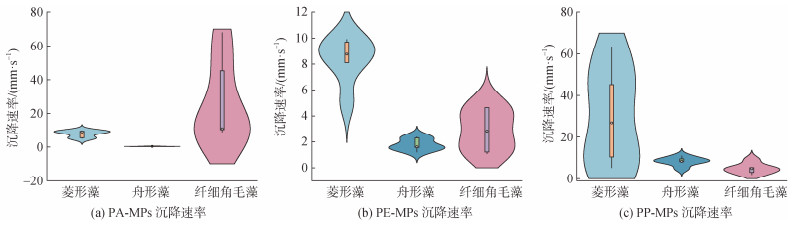 |
| 图 9 不同MPs聚集体的沉降速率 Fig. 9 Sedimentation rates of various MPs aggregates |
 |
| 图 10 回归分析Ws和σ/dMP之间的关系 Fig. 10 Regression analysis of the correlations between Ws and σ/dMP |
结果表明, PA-MPs沉降率均大于70%, 显著高于PE-MPs(32.7%±6.0%)和PP-MPs(18.2%±1.4%)。不同藻种间沉降率差异显著(P < 0.05), 其中Nitzschia sp.组PE-MPs沉降率较其他藻种高21.4%(图 11)。
 |
| 图 11 不同MPs聚集体的沉降率 Fig. 11 Sedimentation rates of different MPs aggregates |
研究表明, PA-MPs的低生物膜覆盖率可能与本身密度高于海水, 在没有硅藻附着的条件下能够沉降(1 080 kg/m3)和酰胺基(—CONH—)亲水性相关[31], 能够降低与硅藻的碰撞频率, 抑制硅藻粘附。Nitzschia sp.对PP/PE的高效包裹能力可能源于其EPS中蛋白质/多糖比例[17], 这与Shiu等[32]提出的EPS粘性调控机制一致。微藻EPS对MPs的捕获和聚集能力受EPS影响[18], 像Tetraselmis sp.产生的EPS能够聚集较小尺寸微塑料。本实验观察到由硅藻和MPs产生类似于海洋雪的聚集体[24-31, 33]。Shiu等[32]研究表明, 浮游植物、MPs和EPS可以形成约30 μm大小的聚集体, 类似于海洋雪。该结构可能有助于MPs密度的增加, 并在微塑料的沉降过程中发挥重要作用[34]。
MPs的沉降与其尺寸密切相关, Ryan[35]指出了不同形状的MPs表面积体积比(SA∶V)的重要性。Fazey等[36]实验表明, 高SA∶V促进生物附着, 微塑料在生物定植后下沉得更快。但本实验中PE -MPs沉降尺寸(27.4~39.0 μm)显著小于理论预测值(~50 μm), 暗示硅藻对MPs的包裹存在一定的选择性。
研究发现, PE-MPs的疏水性及低密度导致其初始浮力较大, 需要积累3~5层生物膜方可触发沉降[23]。本实验中, PE-MPs沉降滞后的现象与[37]提出的疏水衰减速率(k=0.12 d‒1)一致。相较之下, PP-MPs表面迅速氧化, 生物膜积累速率提升, 印证了微塑料的化合物性质对其沉降过程的调控存在明显差异。
此外, 海洋环境的物理特性也会影响MPs聚集体的形成[38]。例如, 河口区域由于浮游植物群落的输入, 易于促进微藻-微塑料聚集体(MA-MPs)的形成[39]。由于潮汐、风和波浪等水动力因素的持续变化, 沿海环境因子的变化较为剧烈[40], 这些因素都能够影响MA-MPs的形成和MPs的环境行为。
3.2 硅藻对MPs沉降的影响Meng等[27]MPs-生物污损模型的结果表明, 生物膜密度的增加缩短了MPs到达沉降临界值的时间, 意味着MPs可能会更快地发生沉降。当采用实测硅藻密度(1 785~1 988 kg/m3)替代传统模型的默认生物膜密度(1 388 kg/m3)时, PP-MPs、PE- MPs达到沉降临界密度(ρ≥1 020 kg/m3)的时间缩短1.2~1.5 d。这种加速效应在PE-MPs中尤为显著, 其固有密度更接近海水, 导致沉降起始时间较PP-MPs提前6~8 h, 与Meng等[27]的理论预测一致。值得注意的是, 高密度生物膜伴随更低的相对厚度(σ/dMP < 10%)。密度越大的生物膜在MPs到达沉降临界值时, 其生物膜厚度σ会更小, 模型结果显示所有的PP和PE-MPs的σ值均不超过其直径的10%, 表明σ对MPs总体尺寸的影响可以忽略不计[41]。
实验观察到Nitzschia sp.组的PE-MPs、PP-MPs沉降速率显著高于其他两组。10 μm球形LDPE和Navicula sp.聚集体的沉降速率在第1周为21.2±2.0 mm·s−1 [24], 而本实验中50 μm PE沉降速率仅为8.34±2.03 mm·s−1, 推测可能是由于聚集体相对疏松, 阻力系数(Cd)增加, 导致其沉降速度(Ws)存在明显差异。先前的研究提到, 由PE球体和Navicula sp.组成的MPs聚集体的沉降速率比桡足类Calanus helgolandicus的粪便颗粒与PS微球的沉降速率快50倍(38 m·d−1)[42]。尽管本研究中Navicula sp.形成的PE-MPs聚集体的沉降速率仅在200~1 000 m·d−1, 低于先前的数据, 但仍然比浮游硅藻Chaetoceros neogracile的2 μm PS球形聚集体(约400 m·d−1)和隐生植物Rhodomonas salina(250 m·d−1)沉降速率快[9-24], 证实硅藻种类对聚集体沉降行为的调控受MPs聚合物类型影响。此外, 微塑料尺寸的差异也可能影响聚集体的沉降。聚集体的密度和形成取决于藻类、MPs和物理环境的特性。因此, 在研究海洋环境中的MA-MPs聚集体时应考虑这些因素。
海洋环境的复杂性不容忽视, 天然环境中, 钙化生物(藤壶、苔藓虫)的附着可使生物膜密度增至4 350 kg/m3[23], 而实验室单物种体系难以模拟这种多营养级的相互作用。在我们的MPs-生物污损模型分析中, 硅藻-MPs的快速下沉被解释为硅藻细胞密度对沉降的显著贡献, 这种密度主要由生物硅构成的细胞支架所驱动。生物源蛋白石的密度(~2 070 kg/m3)显著高于有机物密度[43], 其对颗粒沉降过程的影响尤为重要。生物膜的生长是一个复杂且动态的过程。尽管在我们的模型中假设, 在相同的培养条件和时间下, 不同MPs表面的微生物生物量趋于相对稳定, 但实际情况可能存在显著差异。如在太平洋和大西洋[44]以及地中海[23]采集的微塑料SEM分析表明, 天然MPs生物膜覆盖率普遍低于50%。这与实验室条件下生物膜覆盖率存在一定差异。聚合物表面的疏水性、多孔颗粒结构、孔隙率和渗透性等物理化学特性[45-46]均对MPs的沉降速率和生物膜的形成过程具有重要影响。然而, 这些因素对沉降速率具体影响仍需进一步深入研究和验证。
4 结论和不足塑料工业产量持续增加, 这是海洋环境中MPs持续增加的原因。不同类型的MPs和硅藻在海水中的聚集会影响MPs在水体中的垂直运动。本研究通过室内模拟实验结合MPs-生物污损模型, 揭示生物膜密度增加会使MPs提前0.6~1.5 d发生沉降, 并且生物膜密度每增加100 kg/m3, PE-MPs沉降速率提升18.2%, PP-MPs沉降速率提升5.96%。硅藻定植能够显著增加PE-MPs密度。其中Nitzschia sp. 组对PE-MPs沉降速率和沉降率显著高于其他藻种。对理解MPs在海洋环境中的垂直分布及其对中上层生态系统的影响至关重要。研究结果为理解和预测MPs在海洋环境中的垂直运输提供了新的视角。然而, 实验采用单一硅藻种类及单一塑料类型、尺寸, 难以全面反映真实海洋环境的动态特性。因此, 未来研究需转向更接近自然的实验条件(如自然浮游生物群落或微宇宙实验), 以更准确地评估藻类-微塑料聚集体动态沉降过程。
| [1] |
GOPALAKRISHNAN K AND KASHIAN D R. Extracellular polymeric substances in green alga facilitate microplastic deposition[J]. Chemosphere, 2022, 286: 131814. DOI:10.1016/j.chemosphere.2021.131814 |
| [2] |
SHEN M C, LI Y G, SONG B, et al. Smoked cigarette butts: Unignorable source for environmental microplastic fibers[J]. Science of The Total Environment, 2021, 791: 148384. DOI:10.1016/j.scitotenv.2021.148384 |
| [3] |
GERRITSE J, LESLIE H A, DE TENDER C A, et al. Fragmentation of plastic objects in a laboratory seawater microcosm[J]. Scientific Reports, 2020, 10(1): 10945. DOI:10.1038/s41598-020-67927-1 |
| [4] |
LEE S Y, AN J, KIM J, et al. Enhanced settling of microplastics after biofilm development: A laboratory column study mimicking wastewater clarifiers[J]. Environmental Pollution, 2022, 311: 119909. DOI:10.1016/j.envpol.2022.119909 |
| [5] |
KIM S-K, KIM J-S, KIM S-Y, et al. Arctic Ocean sediments as important current and future sinks for marine microplastics missing in the global microplastic budget[J]. Science Advances, 2023, 9(27): eadd2348. DOI:10.1126/sciadv.add2348 |
| [6] |
KAISER D, KOWALSKI N, AND WANIEK J J. Effects of biofouling on the sinking behavior of microplastics[J]. Environmental Research Letters, 2017, 12(12): 124003. DOI:10.1088/1748-9326/aa8e8b |
| [7] |
LOBELLE D, CUNLIFFE M. Early microbial biofilm formation on marine plastic debris[J]. Marine Pollution Bulletin, 2011, 62(1): 197-200. DOI:10.1016/j.marpolbul.2010.10.013 |
| [8] |
COLE M, LINDEQUE P, FILEMAN E, et al. Microplastic Ingestion by Zooplankton[J]. Environmental Science & Technology, 2013, 47(12): 6646-6655. |
| [9] |
LONG M, MORICEAU B, GALLINARI M, et al. Interactions between microplastics and phytoplankton aggregates: Impact on their respective fates[J]. Marine Chemistry, 2015, 175: 39-46. DOI:10.1016/j.marchem.2015.04.003 |
| [10] |
CARSON H S, NERHEIM M S, CARROLL K A, et al. The plastic-associated microorganisms of the North Pacific Gyre[J]. Marine Pollution Bulletin, 2013, 75(1): 126-132. |
| [11] |
MASÓ M, ALOS J, JUAN S, et al. Microfouling communities from pelagic and benthic marine plastic debris sampled across Mediterranean coastal waters[J]. Scientia Marina, 2016, 80: 117-127. DOI:10.3989/scimar.04281.10A |
| [12] |
DEBROAS D, MONE A, TER HALLE A. Plastics in the North Atlantic garbage patch: A boat-microbe for hitchhikers and plastic degraders[J]. Science of The Total Environment, 2017, 599/600: 1222-1232. DOI:10.1016/j.scitotenv.2017.05.059 |
| [13] |
OBERBECKMANN S, OSBORN A M, DUHAIME M B. Microbes on a bottle: Substrate, season and geography influence community composition of microbes colonizing marine plastic debris[J]. PLoS One, 2016, 11(8): e0159289. DOI:10.1371/journal.pone.0159289 |
| [14] |
KHANDEPARKER L, D'COSTA P M, ANIL A C, et al. Interactions of bacteria with diatoms: influence on natural marine biofilms[J]. Marine Ecology, 2014, 35(2): 233-248. DOI:10.1111/maec.12077 |
| [15] |
ALLDREDGE A L, GOTSCHALK C C. The relative contribution of marine snow of different origins to biological processes in coastal waters[J]. Continental Shelf Research, 1990, 10(1): 41-58. DOI:10.1016/0278-4343(90)90034-J |
| [16] |
WAITE A M, GUSTAFSSON ö, LINDAHL O, et al. Linking ecosystem dynamics and biogeochemistry: Sinking fractionation of organic carbon in a Swedish fjord[J]. Limnology and Oceanography, 2005, 50(2): 658-671. DOI:10.4319/lo.2005.50.2.0658 |
| [17] |
ZHOU Y, CUI X C, WU B B, et al. Microalgal extracellular polymeric substances (EPS) and their roles in cultivation, biomass harvesting, and bioproducts extraction[J]. Biore source Technology, 2024, 406: 131054. |
| [18] |
CUNHA C, FARIA M, NOGUEIRA N, et al. Marine vs freshwater microalgae exopolymers as biosolutions to microplastics pollution[J]. Environmental Pollution, 2019, 249: 372-380. DOI:10.1016/j.envpol.2019.03.046 |
| [19] |
HARRISON J P, HOELLEIN T J, SAPP M, et al. Microplastic-associated biofilms: A comparison of freshwater and marine environments[M]//WAGNER M, LAMBERT S. Freshwater microplastics. The Handbook of Environmental Chemistry, Vol 58. Springer International Publishing, Cham, 2018: 181-201.
|
| [20] |
MORICEAU B, GARVEY M, RAGUENEAU O, et al. Evidence for reduced biogenic silica dissolution rates in diatom aggregates[J]. Marine Ecology Progress Series, 2007, 333: 129-142. DOI:10.3354/meps333129 |
| [21] |
COLE M, LINDEQUE P, FILEMAN E, et al. Microplastic ingestion by zooplankton[J]. Environmental Science & Technology, 2013, 47(12): 6646-6655. |
| [22] |
FARRELL P, NELSON K. Trophic level transfer of microplastic: Mytilus edulis (L.) to Carcinus maenas (L.)[J]. Environmental Pollution, 2013, 177: 1-3. |
| [23] |
AMARAL-ZETTLER L A, ZETTLER E R, MINCER T J, et al. Biofouling impacts on polyethylene density and sinking in coastal waters: A macro/micro tipping point?[J]. Water Research, 2021, 201: 117289. DOI:10.1016/j.watres.2021.117289 |
| [24] |
LIM Y K, LEE K W, HONG S H, et al. Differential impact of planktonic and periphytic diatoms on aggregation and sinking of microplastics in a simulated marine environment[J]. Marine Pollution Bulletin, 2024, 199: 115961. DOI:10.1016/j.marpolbul.2023.115961 |
| [25] |
YOSHITAKE M, ISOBE A, SONG Y K, et al. A numerical model approach toward a settling process and feedback loop of ocean microplastics absorbed into phytoplankton aggregates[J]. Journal of Geophysical Research: Oceans, 2023, 128(5): e2022JC018961. DOI:10.1029/2022JC018961 |
| [26] |
WALDSCHLäGER K, SCHÜTTRUMPF H. Effects of particle properties on the settling and rise velocities of microplastics in freshwater under laboratory conditions[J]. Environmental Science & Technology, 2019, 53(4): 1958-1966. |
| [27] |
MENG D Z, LI Y Z. Assessing the settling velocity of biofilm-encrusted microplastics: Accounting for biofilms as an equivalent to surface roughness[J]. Environmental Science & Technology, 2024, 58(2): 1329-1337. |
| [28] |
SHEN X, LIN M, CHONG H, et al. Settling and rising velocities of microplastics: Laboratory experiments and lattice Boltzmann modeling[J]. Environmental Pollution, 2024, 363: 125107. DOI:10.1016/j.envpol.2024.125107 |
| [29] |
LI C, BAI X, KRAUSE S, et al. Prediction of vertical transport of microplastics: Shape- and aging-dependent drag models[J]. Journal of Hazardous Materials, 2024, 480: 136412. DOI:10.1016/j.jhazmat.2024.136412 |
| [30] |
KOOI M, NES E H V, SCHEFFER M, et al. Ups and downs in the ocean: Effects of biofouling on vertical transport of microplastics[J]. Environmental Science & Technology, 2017, 51(14): 7963-7971. |
| [31] |
MENDRIK F, FERNÁNDEZ R, HACKNEY C R, et al. Non-buoyant microplastic settling velocity varies with biofilm growth and ambient water salinity[J]. Communications Earth & Environment, 2023, 4(1): 30. |
| [32] |
SHIU R F, VAZQUEZ C I, CHIANG C Y, et al. Nano- and microplastics trigger secretion of protein-rich extracellular polymeric substances from phytoplankton[J]. Science of The Total Environment, 2020, 748: 141469. DOI:10.1016/j.scitotenv.2020.141469 |
| [33] |
GALGANI L, GOßMANN I, SCHOLZ-BöTTCHER B, et al. Hitchhiking into the Deep: How microplastic particles are exported through the biological carbon pump in the North Atlantic Ocean[J]. Environmental Science & Technology, 2022, 56(22): 15638-15649. |
| [34] |
NAVA V, LEONI B. A critical review of interactions between microplastics, microalgae and aquatic ecosystem function[J]. Water Research, 2021, 188: 116476. DOI:10.1016/j.watres.2020.116476 |
| [35] |
RYAN P G. Does size and buoyancy affect the long- distance transport of floating debris?[J]. Environmental Research Letters, 2015, 10(8): 084019. DOI:10.1088/1748-9326/10/8/084019 |
| [36] |
FAZEY F M C, RYAN P G. Biofouling on buoyant marine plastics: An experimental study into the effect of size on surface longevity[J]. Environmental Pollution, 2016, 210: 354-360. DOI:10.1016/j.envpol.2016.01.026 |
| [37] |
BRAVO M, ASTUDILLO J, LANCELLOTTI D, et al. Rafting on abiotic substrata: Properties of floating items and their influence on community succession[J]. Marine Ecology Progress Series, 2011, 439: 1-17. |
| [38] |
JACKSON G A. A model of the formation of marine algal flocs by physical coagulation processes[J]. Deep Sea Research Part A. Oceanographic Research Papers, 1990, 37(8): 1197-1211. DOI:10.1016/0198-0149(90)90038-W |
| [39] |
WANG T, ZHAO S Y, ZHU L X, et al. Accumulation, transformation and transport of microplastics in estuarine fronts[J]. Nature Reviews Earth & Environment, 2022, 3(11): 795-805. |
| [40] |
VERMEIREN P, MUñOZ C C, IKEJIMA K. Sources and sinks of plastic debris in estuaries: A conceptual model integrating biological, physical and chemical distribution mechanisms[J]. Marine Pollution Bulletin, 2016, 113(1): 7-16. |
| [41] |
LI J S, SHAN E C, ZHAO J M, et al. The factors influencing the vertical transport of microplastics in marine environment: A review[J]. Science of The Total Environment, 2023, 870: 161893. DOI:10.1016/j.scitotenv.2023.161893 |
| [42] |
COLE M, LINDEQUE P K, FILEMAN E, et al. Microplastics alter the properties and sinking rates of zooplankton faecal pellets[J]. Environmental Science & Technology, 2016, 50(6): 3239-3246. |
| [43] |
BOYD C, GRADMANN D. Impact of osmolytes on buoyancy of marine phytoplankton[J]. Marine Biology, 2002, 141(4): 605-618. DOI:10.1007/s00227-002-0872-z |
| [44] |
AMARAL-ZETTLER L A, ZETTLER E R, SLIKAS B, et al. The biogeography of the Plastisphere: implications for policy[J]. Frontiers in Ecology and the Environment, 2015, 13(10): 541-546. DOI:10.1890/150017 |
| [45] |
IVERSEN M H, NOWALD N, PLOUG H, et al. High resolution profiles of vertical particulate organic matter export off Cape Blanc, Mauritania: Degradation processes and ballasting effects[J]. Deep Sea Research Part Ⅰ: Oceanographic Research Papers, 2010, 57(6): 771-784. DOI:10.1016/j.dsr.2010.03.007 |
| [46] |
XIAO F, LI X Y, LAM K, et al. Investigation of the hydrodynamic behavior of diatom aggregates using particle image velocimetry[J]. Journal of Environmental Sciences, 2012, 24(7): 1157-1164. DOI:10.1016/S1001-0742(11)60960-1 |