 2026, Vol. 50
文章信息
- 付敬强, 张馨予, 赵梅英, 聂林蔚, 郭团玉, 骆轩, 邹伟广, 梁园, 沈铭辉, 游伟伟, 柯才焕. 2026.
- Fu Jingqiang, Zhang Xinyu, Zhao Meiying, Nie Linwei, Guo Tuanyu, Luo Xuan, Zou Weiguang, Liang Yuan, Shen Minghui, You Weiwei, Ke Caihuan. 2026.
- 方斑东风螺两个地理群体间杂交后代及其自交后代的遗传多样性和遗传结构分析
- Analysis of genetic diversity and structure between hybrid offspring and their inbred offspring of two geographical populations in Babylonia areolata
- 海洋科学, 50(1): 26-34
- Marine Sciences, 50(1): 26-34.
- http://dx.doi.org/10.11759/hykx20251101001
-
文章历史
- 收稿日期:2025-11-01
- 修回日期:2025-12-05


2. 厦门大学 海水养殖生物育种全国重点实验室/海洋与地球学院, 福建 厦门 361102;
3. 海南省海洋与渔业科学院 海南省热带海水养殖技术重点实验室, 海南 海口 571126;
4. 福建省海洋经济生物遗传育种重点实验室, 福建 厦门 361102
2. State Key Laboratory of Mariculture Breeding/College of Ocean and Earth Sciences, Xiamen University, Xiamen 361102, China;
3. Hainan Academy of Ocean and Fisheries Sciences, Hainan 571216, China;
4. Fujian Key Laboratory of Genetics and Breeding of Marine Organisms, Xiamen 361102, China
方斑东风螺(Babylonia areolata)俗称花螺, 为热带、亚热带海域的腐肉食性浅海底栖腹足类动物, 在我国主要分布于福建、广东、广西和海南等东南沿海地区[1]。方斑东风螺生长速度快, 肉质鲜美, 氨基酸含量丰富, 富含人体所需的EPA和DHA[2-3], 深受消费者青睐, 是我国重要的经济贝类[4]。然而, 方斑东风螺的养殖业目前也存在一些问题, 包括环境恶化、种质退化、抗性下降、病害频发及大规模死亡等问题[5-6]。因此, 亟需对其养殖性状进行遗传改良, 以提高其在养殖过程中的成活率, 促进东风螺养殖产业的健康发展。
杂交育种作为一种经典且高效的育种手段, 广泛应用于水产动物优良品种的培育[7]。通过杂交, 可将不同亲本的优良性状相结合, 使子代在某些性状上表现出杂种优势[8-9]。因此, 其在水产动物品种改良, 预防种质退化方面发挥了重要作用。如太平洋牡蛎(Crassostrea gigas)“海大1号”(HH)与橙壳品系(OO)的杂交子代(OH, 即OO♀×HH♂)在生长性状、营养品质和繁殖潜力方面均表现出杂种优势[10]。虾夷扇贝(Patinopecten yessoensis)与风向标扇贝(P. caurinus)的杂交子代(Py♀×Pc♂)在高温和低温胁迫下的存活率、壳高生长率和整体体重均表现出显著杂种优势[11]。菲律宾蛤仔(Ruditapes philippinarum)莱州和湛江2个群体杂交子代(湛江♀×莱州♂)的壳长和壳高在20日龄时杂种优势率分别达到33.42%和33.13%, 存活率在整个幼虫及稚贝阶段比自交组高25%~40%[12]。马氏珠母贝(Pinctada martensii)2个地理群体杂交子代在壳高、壳长和壳质量等性状上表现出杂种优势, 且其杂合度和遗传多样性均高于自交子代[13]。杂合度和遗传多样性的提升通常与杂种优势密切相关, 王佩佩等[14]对河川沙塘鳢(Odontobutis potamophila)3个地理群体进行3×3完全双列杂交, 发现建德(♂)×当涂(♀)组合在全长与体重增长方面杂种优势率最高, 其等位基因数与多态信息含量也大于其他组合。
杂交育种在方斑东风螺的遗传改良中同样有重要的育种实践价值。前期的研究表明, 方斑东风螺泰国群体和海南群体的杂交子代在壳长、体重、抗逆和抗病等性状上均表现出显著杂种优势[15-17], 但二者的杂种优势是如何形成的尚不清楚。本研究以泰国与海南两地理群体的方斑东风螺为亲本, 通过2×2完全双列杂交设计, 利用微卫星标记分析各组合子代的遗传多样性和遗传变异, 以期为2个群体杂交子代的杂种优势解析提供新的见解。
1 材料与方法 1.1 实验材料以方斑东风螺泰国第4代选育群体与海南野生群体为亲本, 采用2×2完全双列杂交法建立4种组合子代(表 1)。每种组合培育出7~9个全同胞家系, 随机从每种组合中选取3个家系, 每个家系随机选取10只个体, 共30只个体代表一种组合。对每种组合中选取的30只个体进行解剖, 取部分足部肌肉于75%的酒精溶液中保存, 以备提取DNA。
| 泰国方斑东风螺(Thailand B. areolata)(T, ♂) | 海南方斑东风螺(Hainan B. areolata)(H, ♂) | |
| 泰国方斑东风螺 (Thailand B. areolata)(T, ♀) |
TT | TH |
| 海南方斑东风螺 (Hainan B. areolata)(H, ♀) |
HT | HH |
| 注: TT为泰国方斑东风螺自交子代, TH为雌性泰国方斑东风螺(♀)与雄性海南方斑东风螺(♂)杂交子代, HT为雌性海南方斑东风螺(♀)与雄性泰国方斑东风螺(♂)杂交子代, HH为海南方斑东风螺自交子代。 | ||
使用天根生化科技有限公司的海洋动物组织基因组DNA提取试剂盒, 按产品使用说明书提取DNA。通过1%的琼脂糖凝胶电泳检测DNA的完整性, Nano Drop2000测定DNA的浓度和纯度, 然后−20 ℃保存备用。
1.2.2 微卫星引物的筛选共选用到14对微卫星标记(表 2), 其中HUBA08和HUBA22来自Wang等[18]发表的多态性微卫星标记; HUBA01和HUBA18引自Zhang等[19]报道的微卫星标记; 其余10个标记详见笔者先前发表的论文[20]。引物由上海生工生物有限公司合成。
| 位点/登记号 | 引物序列(5′–3′) | 重复单元 | 退火温度/℃ | 片段大小/bp | 文献 |
| HUBA08/FJ595005 | Fa: AGCAGCCTAACATACGCACAC Ra: ATTGAATTGCAGTTGGGGAAC |
(GA)n(GACA)N | 62 | 166~236 | [18] |
| HUBA22/FJ595019 | F: GGCAACAAAACTTTCACTTCG R: CTTCATTGCTGTCCTTTCCAC |
(CA)N | 62 | 205~241 | [18] |
| HUBA01/FJ594998 | F: TGTGACATGAACAAGGGACTTC R: AGGAAACTCAGAGCATTCGTG |
(TG)n | 62 | 302~340 | [19] |
| HUBA18/FJ595015 | F: TACGACGTGTTTGACGTGTTG R: TGACCTCACGCAAGAAAAGAG |
(TC)N(TTC)N (GTG)N |
60 | 390~430 | [19] |
| DC-100/FJ041057 | F: TACATGCATACATACAGC R: CACCTCATTTAAGTCTTC |
(AC)26 | 46.1 | 135~175 | [20] |
| DC-114/FJ041058 | F: AAGGTGGGAGGAAAGAGT R: TTAATAATACGCACATGC |
(GT)10 | 48.4 | 175~191 | [20] |
| D-97/EU589453 | F: ACTGGAACAGACCCGTGAACACTT R: TGACTGCCATTGGCTGAACATTAT |
(GT)3CT(GT)8 | 52.6 | 274~306 | [20] |
| D-87/EU589454 | F: CCAAGGCACTTCGCCGTTA R: ATAAACTTGAAACAAGACAGCAAACAG |
(ACAA)5 | 48.6 | 72~84 | [20] |
| D-88/EU589455 | F: TTACTCTACAAACCATAAGAAATAAACTC R: ATGATGCCCTTTCTGTCTTCTC |
(GT)16 | 50 | 121~141 | [20] |
| DC-50/EU589456 | F: AAGCCACGGAACGCATCGC R: CGGTCGGTGAATGGAACTGATA |
(ATC)5 | 54.9 | 100~110 | [20] |
| DC-111/EU589458 | F: TGAATAGGAAAATGTGGACGC R: TGAAGAACGCACGTTACAAAG |
(GA)4... (AG)3 T(GA)6 |
49.9 | 350~370 | [20] |
| D22-1/FJ176760 | F: ATCGTTTGGTGTTGGACA R: GGAGGGACGGCACGGTATTT |
(GA)4…(AG)3 T(GA)6 (CT)18 |
51.1 | 105~146 | [20] |
| D38-1/FJ176763 | F: GGGCAGCAGTTATCTGTACTCACC R: GGAGAAAATGTCACTTGGAGCAG |
(AC)12 | 55.9 | 189~209 | [20] |
| D-2-13-1/FJ176766 | F: CTACCCGCACCCAATCAC R: CGGAGCTCGTCACCAAGA |
(AG)28 | 52.9 | 158~226 | [20] |
| 注: F. forward primer, 上游引物; R. reverse primer, 下游引物; N. pure, 连续的微卫星序列; n. interrupted, 有间隔的微卫星序列。 | |||||
PCR扩增体系选择与反应程序设置参照笔者先前研究[20]。用1%的琼脂糖凝胶电泳检测PCR产物, 在凝胶成像系统中观察是否扩增出目的片段。将扩增出的PCR产物送往上海生工生物有限公司利用ABI 3500xl基因分析仪进行毛细管电泳, 检测荧光信号并利用GeneMarker 4.0软件分析微卫星位点的片段长度。
1.2.4 数据处理及分析使用GenAlEx 6.5软件[21]计算4种组合的等位基因数(number of alleles, Na)、有效等位基因数(effective number of alleles, Ne)、观测杂合度(observed heterozygosity, Ho)、期望杂合度(expected heterozygosity, He)、Shannon’s信息指数(Shannon’s information index, I)和遗传距离(genetic distance, GD)。同时对不同组合进行主坐标分析(principal coordinates analysis, PCoA)分析。采用Arlequin 3.5软件[22]对各组合进行分子方差分析(analysis of molecular variance, AMOVA), 并计算各组合间的遗传分化指数(Fst)。此外, 利用STRUCTURE 2.3.3软件[23]分析不同组合的遗传结构。
2 结果 2.1 遗传多样性分析利用14对多态性微卫星标记对4种组合的子代进行PCR扩增, 经统计分析, 其遗传多样性信息见表 3。4种组合子代的等位基因数(Na)、有效等位基因数(Ne)的变化范围分别为(3.40±0.39)~(4.80±0.63)与(2.73± 0.24)~(3.42±0.40), 各组合间差异不显著(P>0.05), 2个多样性指数的大小顺序均为HT>TH>HH>TT。观测杂合度(Ho)与期望杂合度(He)的变化范围分别为(0.69± 0.01)~(0.71±0.08)与(0.58±0.08)~(0.65±0.05), TH和HT组合的杂合度略高于自交组合, 但差异不显著(P>0.05)。另外, 4种组合的Shannon’s信息指数(I)的大小变化趋势与Na和Ne相同, 即为HT>TH>HH>TT。上述结果表明, 各多样性指数大小的变化较为一致, 杂交子代的遗传多样性均高于自交子代。
| 群体 | 参数 | ||||
| Na | Ne | Ho | He | I | |
| TT | 3.40±0.39a | 2.73±0.24a | 0.69±0.08a | 0.60±0.05a | 1.06±0.09a |
| TH | 4.20±0.45a | 3.26±0.33a | 0.71±0.08a | 0.65±0.05a | 1.20±0.11a |
| HT | 4.80±0.63a | 3.42±0.40a | 0.70±0.08a | 0.65±0.05a | 1.25±0.12a |
| HH | 4.07±0.67a | 3.14±0.49a | 0.69±0.10a | 0.58±0.08a | 1.13±0.16a |
| 注: 同一列中字母相同表示组合间差异不显著(P>0.05), 字母不同表示组合间差异显著(P<0.05); TT为泰国方斑东风螺自交子代, TH为雌性泰国方斑东风螺(♀)与雄性海南方斑东风螺(♂)杂交子代, HT为雌性海南方斑东风螺(♀)与雄性泰国方斑东风螺(♂)杂交子代, HH为海南方斑东风螺自交子代。 | |||||
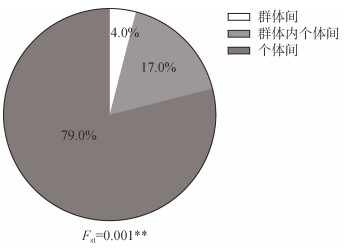
4种组合子代的遗传分化系数(Fst)分析结果如表 4所示, Fst的变化范围在0.100~0.180之间, 表明组合间存在中等以上遗传分化。其中TT和HH之间的遗传分化最大(Fst = 0.180), TH和HT之间的遗传分化最小(Fst = 0.100)。各组合子代间遗传距离(GD)的变化趋势与遗传分化保持一致, GD的变化范围在0.500~1.160之间。分子方差分析(AMOVA)显示, 4.0%的变异来源于各组合间, 17.0%的变异来源于组合内个体间, 变异主要来源于个体内(79.0%)(图 1)。
| TT | TH | HT | HH | |
| TT | 0.000 | 0.838 | 0.846 | 1.160 |
| TH | 0.137 | 0.000 | 0.500 | 0.724 |
| HT | 0.144 | 0.100 | 0.000 | 0.653 |
| HH | 0.180 | 0.131 | 0.122 | 0.000 |
| 注: TT为泰国方斑东风螺自交子代, TH为雌性泰国方斑东风螺(♀)与雄性海南方斑东风螺(♂)杂交子代, HT为雌性海南方斑东风螺(♀)与雄性泰国方斑东风螺(♂)杂交子代, HH为海南方斑东风螺自交子代。 | ||||
 |
| 图 1 方斑东风螺泰国群体和海南群体间杂交子代及其自交子代的分子方差分析 Fig. 1 Analysis of the molecular variance between hybrid and self-bred offspring of Thailand and Hainan populations of Babylonia areolata |
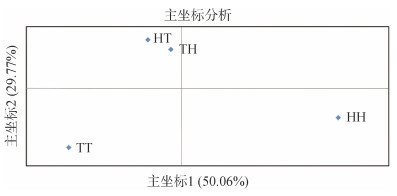
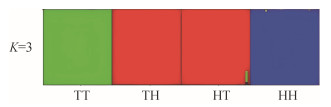
如图 2所示, 在进行4种组合子代的主成分分析时发现, 自交子代TT和HH在主成分1上存在明显的分离, 分别位于第三象限和第四象限, 2种杂交子代TH和HT聚集较为接近, 均分布于第二象限, 与2种自交子代存在清晰的分离。此外, Structure的分析结果同样支持PCoA结果, 即K=3时, TH和HT聚为一簇, TT与HH分别独自成为一簇(图 3)。
 |
| 图 2 方斑东风螺泰国群体和海南群体间杂交子代及其自交子代的主成分分析 Fig. 2 PCoA analysis between hybrid and self-bred offspring of Thailand and Hainan populations of Babylonia areolata |
 |
| 图 3 方斑东风螺泰国群体和海南群体间杂交子代及其自交子代的Structure分析 Fig. 3 Structural analysis between the hybrid and self-bred offspring of Thailand and Hainan populations of Babylonia areolata |
遗传多样性就是生物所携带遗传信息的总和, 是生物多样性的核心组成部分。种群的遗传多样性水平主要受交配系统、物种的进化历史、种群历史及环境异质性水平影响[17], 且物种对复杂环境的适应能力、生存维持及进化潜力均与遗传多样性密切相关。通常而言, 物种的遗传变异越丰富, 其对环境变化的适应能力越强[24], 而最大限度地维持种内遗传多样性, 是种质资源高效利用的前提与基础。东风螺作为我国东南沿海重要的海水经济养殖贝类, 目前对其群体遗传多样性的系统性调查研究较少, 且尚未见关于东风螺杂交育种过程中遗传多样性和遗传变异的研究报道。
在水生动物育种中, 通过种群间或品系间杂交改良遗传性状, 已成为经济养殖品种育种的有效途径[8, 25], 在此过程中, 杂交子代因继承双亲的遗传信息, 往往具有高于亲本的遗传多样性, 同时在部分性状上表现出杂种优势。如以墨西哥湾扇贝(Argopecten irradians concentricus)为母本, 扇贝“渤海红”为父本培育的杂交后代遗传多样性较高, 该杂交子代在浮游阶段壳长和壳高杂种优势率范围分别为7.7%~20.5%, 并在各养成阶段均表现出杂种优势[26]; 马氏珠母贝2个地理群体正反交子代的遗传多样性均大于自交群体, 且在生长相关性状上表现出杂种优势[13]; 此外, 紫扇贝(A. purpuratus)与海湾扇贝(A. irradians)的正反交子代遗传多样性显著高于紫扇贝[27-28], 且生长率和养成存活率也明显优于紫扇贝[29]。
本研究中, 利用目前在东风螺中已报道的14对高质量的多态性微卫星标记对方斑东风螺泰国群体和海南群体间杂交子代及其自交子代进行遗传多样性和遗传变异分析[20, 30], HH组合亲本来源于野生群体, 而TT组合亲本来源于泰国第4代选育群体, 连续多代的选择与自交导致遗传多样性下降, 可能是TT组合遗传多样性水平低于HH组合的主要原因, 这与先前研究报道结果一致[20, 31]。此外, 对TH、HT及两亲本自交子代的遗传多样性差异分析显示, TH和HT的等位基因数(Na)分别为4.20±0.45、4.80±0.63, 均高于两亲本自交子代; 且正反交子代的Ho和He也均高于两亲本自交子代, 表现出更丰富的遗传多样性。类似结果在凡纳滨对虾(Litopenaeus vannamei)[32-33]及大口黑鲈(Micropterus salmoides)[34]的杂交育种也有发现。从参数变化来看, Na、Ho和He的提升不仅直观反映了杂交子代遗传基础的拓宽, 更意味着其在应对环境波动和病害威胁时具备更强的适应性潜力。付敬强[2]、Lü等[15]、Fu等[16-17]观察到方斑东风螺该杂交组合子代在生长、耐低盐与抗哈维氏弧菌感染性状上存在杂种优势。本研究基于遗传多样性层面的分析结果, 为上述性状的增益效应提供了潜在的遗传学解释——该杂交组合遗传多样性的提高扩大了遗传变异范围, 其中富集的有益变异可能是介导生长、抗逆等经济性状杂种优势产生的核心因素。这为从分子层面理解东风螺杂种优势形成机制提供了一些参考。
遗传距离与分化系数分析表明, TH与HT在遗传上更接近母本。前期的研究表明, TT的生长速度显著快于HH, HH的抗弧菌感染能力显著强于TT; 而在杂交子代中, TH的生长性能优于HT, HT的抗弧菌感染能力强于TH, 上述性状均表现出母体效应[15, 35]。杂交后代遗传特性偏向一方亲本是常见一种现象, 如哲罗鲑(Hucho taimen)与细鳞鲑(Brachymystax lenok)的正反交子代, 与两自交子代的遗传差异不对等, 且在遗传上均偏向母本[35]; 三角鲂(Megalobrama amblycephala)与团头鲂(M. terminalis)的杂交子代体形均表现为偏母本遗传[36]; 紫扇贝和海湾扇贝的杂交子代与两自交子代的遗传关系也不完全对等, 虽无明显的倾向性, 但均略偏向母本[37]; 类似的, 文蛤2个地理群体的杂交中, 杂交子一代的生长和遗传差异也表现出明显的母体效应[38]。母体效应在杂种优势中广泛存在, 其形成受线粒体基因和核基因共同调控[37-38]。遗传距离与分化系数所揭示的母本偏向性, 为方斑东风螺特定优良性状的定向选育提供重要指引。例如, 若以生长为目标, 可优先选择TT为母本构建TH组合; 若侧重抗病性, 则HT组合更具潜力。这种基于遗传参数的亲本选配策略, 可有效提高杂交育种的精准性, 减少盲目试验造成的成本浪费, 同时深化对海水贝类母体效应调控杂种优势机制的理解, 为解析遗传特性与经济性状的关联路径提供关键线索。
杂交能产生杂种优势的根本原因在于: 杂交过程中, 来自于2个或2个以上遗传基础不同的种类、种群或品系的个体发生基因自由组合, 形成新的遗传类型, 导致杂交子代遗传结构改变[39]。魏继海等[40]提出, 杂种优势的强弱受亲本自身遗传差异影响, 在一定的范围内, 两亲本的遗传差异越大, 杂交子代越易表现出更高的杂种优势[41]。而亲本间的遗传差异大小可通过遗传分化与遗传结构差异进行比较。本研究中, TT与HH的遗传分化最大(Fst=0.180), 达到高等分化水平[42], 而且主成分和Structure的结果均显示两群体存在显著遗传差异。此外, 正反交子代与两自交子代的遗传分化均表现为中等分化水平, 且在遗传结构上呈现出明显差异。这一结果反映出杂交子代的遗传分化与遗传多样性特点: 来源不同的群体杂交时, 后代等位基因发生重组, 遗传变异增加, 可能促使杂交后代在部分性状上表现出杂种优势[43]。TT与HH高遗传分化不仅验证了“亲本遗传差异越大, 杂种优势潜力越高”的推论, 更为方斑东风螺杂交育种亲本选择提供重要参考——优先选择遗传分化程度高的群体进行杂交, 可能会更高效地激发子代的杂种优势。而正反交子代呈现的中等分化水平这一现象表明, 杂交过程中的基因重组有效融合了双亲的遗传基础, 并可能催生了新的适应性变异。这种遗传结构的优化, 为子代在生长、抗逆等性状上的综合提升奠定了内在基础。同时, 该结果也为后续研究方斑东风螺杂交后代的遗传稳定性及开展良种选育提供了重要理论依据。
4 结论本研究借助微卫星标记分析证实, 选用遗传分化显著的方斑东风螺地理群体作为亲本进行杂交, 能有效提升子代遗传多样性, 且杂交子代与自交子代之间呈现显著的遗传分化与结构变异, 这为杂交子代获得生长、抗逆等杂种优势提供了遗传学基础。该结论不仅为方斑东风螺杂交育种的亲本选择提供了直接依据, 也进一步丰富了海水贝类杂交优势的遗传理论认识, 对后续良种选育与产业化应用具有参考价值。未来可在此基础上深入解析杂种优势的遗传机制, 推动优良品种的稳定培育。
| [1] |
Zou Y, Fu J Q, Liang Y, et al. Chromosome-level genome assembly of the ivory shell Babylonia areolata[J]. Scientific Data, 2024, 11(1): 1201. DOI:10.1038/s41597-024-04001-9 |
| [2] |
付敬强. 方斑东风螺杂交种的环境耐受性和抗弧菌感染杂种优势研究[D]. 厦门: 厦门大学, 2021. Fu Jingqiang. Study on environmental tolerance and heterosis of anti-Vibrio defense in Babylonia areolata hybrids[D]. Xiamen: Xiamen University, 2021. |
| [3] |
Hong X, Sun Y C, Liu J, et al. Effects of alanine supplementation on the growth, biochemical composition and appetite of ivory shell (Babylonia areolata)[J]. Aquaculture International, 2025, 33(5): 325. DOI:10.1007/s10499-025-01998-7 |
| [4] |
付敬强, 游伟伟, 骆轩, 等. 东风螺生物学与遗传育种研究进展[J]. 厦门大学学报(自然科学版), 2023, 62(3): 356-364. Fu Jingqiang, You Weiwei, Luo Xuan, et al. Advances in biology and genetic breeding of Babylonia[J]. Journal of Xiamen University (Natural Science), 2023, 62(3): 356-364. |
| [5] |
Dai C, Luo D P, Liu Q, et al. Transcriptome analysis of multiple tissues in the Babylonia areolata reveals the distinct response to Vibrio tubiashii infection[J]. Aquaculture Reports, 2025, 43: 102974. DOI:10.1016/j.aqrep.2025.102974 |
| [6] |
Dai C, Li X X, Luo D P, et al. First report on genome analysis and pathogenicity of vibrio tubiashii FP17 from farmed ivory shell (Babylonia areolata)[J]. Fishes, 2022, 7(6): 396. DOI:10.3390/fishes7060396 |
| [7] |
Zhou M C, Zhang J P, Huang M, et al. Genetic variation between a hybrid abalone and its parents (Haliotis discus hannai♀ and H. fulgens♂) based on 5S rDNA gene and genomic resequencing[J]. Aquaculture, 2024, 579: 740173. DOI:10.1016/j.aquaculture.2023.740173 |
| [8] |
Wang J J, Liu O Y, Shen M, et al. Three-way crossed scallops between Argopecten irradians irradians, A. i. concentricus and A. purpuratus exhibit strong heterosis in growth, survival and temperature tolerance[J]. Aquaculture, 2025, 596: 741866. DOI:10.1016/j.aquaculture.2024.741866 |
| [9] |
Zhang H, Li R, Zeng Y, et al. Novel screening of molecular markers reveals genetic basis for heterosis in hybrids from red crucian carp and white crucian carp[J]. Aquaculture, 2025, 599: 742098. DOI:10.1016/j.aquaculture.2024.742098 |
| [10] |
Liang Y X, Fand J F, Xu C X, et al. Effects of hybridization on growth, nutrition and reproductive potentiality of the Pacific oyster: Examination of annual variation in phenotypic and biochemical composition[J]. Aquaculture, 2025, 601: 742288. DOI:10.1016/j.aquaculture.2025.742288 |
| [11] |
Xing Q, Yang Z J, Zhu X H, et al. Interspecific hybridization between Patinopecten yessoensis (♀) and P. caurinus (♂) with heterosis in growth and temperature tolerance[J]. Aquaculture, 2022, 547: 737489. DOI:10.1016/j.aquaculture.2021.737489 |
| [12] |
Wang S L, Wei D, Cui Z Y, et al. Crossbreeding of two populations of Ruditapes philippenarum reveals high growth and survival heterosis[J]. Aquaculture, 2024, 578: 740087. DOI:10.1016/j.aquaculture.2023.740087 |
| [13] |
王爱民, 王嫣, 顾志峰, 等. 马氏珠母贝(Pinctada martensii)2个地理群体杂交子代的杂种优势和遗传变异[J]. 海洋与湖沼, 2010, 41(1): 140-147. Wang Aimin, Wang Yan, Gu Zhifeng, et al. Heterosis and genetic variation of hybrids from two geographical populations of pearl oyster, Pinctada martensii[J]. Oceanologia et Limnologia Sinica, 2010, 41(1): 140-147. |
| [14] |
王佩佩, 丁严冬, 于兴达, 等. 河川沙塘鳢3个不同地理群体杂交F1代生长性能及遗传多样性[J]. 水产科学, 2016, 35(5): 528-534. Wang Peipei, Ding Yandong, Yu Xingda, et al. Growth trait and genetic diversity in the F1 progeny of dark sleeper Odontobutis potamophila from three diffetent populations[J]. Fisheries Science, 2016, 35(5): 528-534. |
| [15] |
Lü W G, Ke C H, Fu J Q, et al. Evaluation of crosses between two geographic populations of native Chinese and introduced Thai spotted ivory shell, Babylonia areolata, in southern China[J]. Journal of the World Aquaculture Society, 2016, 47(4): 544-554. DOI:10.1111/jwas.12290 |
| [16] |
Fu J Q, Nie L W, Xia G Y, et al. Changes in low salinity and hypoxia tolerance in F1 hybrids of the ivory shell, Babylonia areolata[J]. Aquaculture Reports, 2024, 36: 102131. DOI:10.1016/j.aqrep.2024.102131 |
| [17] |
Fu J Q, Liang Y, Shen M H, et al. Survival and immune responses of two populations of Babylonia areolata and their hybrids under pathogenic Vibrio challenge[J]. Aquaculture, 2024, 584: 740646. DOI:10.1016/j.aquaculture.2024.740646 |
| [18] |
Wang Y, Lu H, Zheng J, et al. Eight polymorphic microsatellite markers for the spotted babylon, Babylonia areolata (Buccinidae)[J]. Genetics and Molecular Research, 2011, 10(4): 3230-3235. DOI:10.4238/2011.December.21.5 |
| [19] |
Zhang N, Qiu Y, Huang X Z, et al. Microsatellite marker development and characterization in the spotted babylon, Babylonia areolata (Link, 1807): detection of duplicated loci at high frequency[J]. International Journal of Aquaculture, 2012, 2(2): 5-10. |
| [20] |
Fu J Q, Lü W G, Li W D, et al. Comparative assessment of the genetic variation in selectively bred generations from two geographic populations of ivory shell (Babylonia areolata). Aquaculture Research, 2017, 48(8): 4205-4218.
|
| [21] |
Peakall R, Smouse P E. GenAlEx 6.5: genetic analysis in Excel. Population genetic software for teaching and research: an update[J]. Bioinformatics, 2012, 28(19): 2537-2539. DOI:10.1093/bioinformatics/bts460 |
| [22] |
Excoffier L, Lischer H E. Arlequin suite ver 3.5: a new series of programs to perform population genetics analyses under Linux and Windows[J]. Molecular Ecology Resources, 2010, 10(3): 564-567. DOI:10.1111/j.1755-0998.2010.02847.x |
| [23] |
Evanno G, Regnaut S, Goudet J. Detecting the number of clusters of individuals using the software STRUCTURE: a simulation study[J]. Molecular Ecology, 2005, 14(8): 2611-2620. DOI:10.1111/j.1365-294X.2005.02553.x |
| [24] |
Dong F, Cheng P L, Sha H, et al. Genetic diversity and population structure analysis of blunt snout bream (Megalobrama amblycephala) in the Yangtze River Basin: Implications for conservation and utilization[J]. Aquaculture Reports, 2024, 35: 101925. DOI:10.1016/j.aqrep.2024.101925 |
| [25] |
Xiao Q Z, Shen Y W, Gan Y, et al. Three-way cross hybrid abalone exhibit heterosis in growth performance, thermal tolerance, and hypoxia tolerance[J]. Aquaculture, 2022, 555: 738231. DOI:10.1016/j.aquaculture.2022.738231 |
| [26] |
展建强. 墨西哥湾扇贝野生原种引进及育成杂交的遗传多样性比较[D]. 湛江: 广东海洋大学, 2023. Zhan Jianqiang. Comparison of genetic diversity of wild scallop species introduced and bred hybrids of Argopecten irradians concentricus[D]. Zhanjiang: Guangdong Ocean University, 2023. |
| [27] |
孙妍, 黄晓婷, 胡丽萍, 等. 紫扇贝、海湾扇贝及其正反杂交子代群体遗传结构的AFLP分析[J]. 海洋科学, 2013, 37(8): 1-5. Sun Yan, Huang Xiaoting, Hu Liping, et al. AFLP analysis of genetic structure of Argopecten purpuratus, Argopecten irradians and their positive and negative hybrid offspring[J]. Marine Sciences, 2013, 37(8): 1-5. |
| [28] |
Hu L P, Huang X T, Sun Y, et al. Molecular genetic analysis of heterosis in interspecific hybrids of Argopecten purpuratus × A. irradians irradians[J]. Genetics and Molecular Research, 2015, 14(3): 10692-10704. DOI:10.4238/2015.September.9.9 |
| [29] |
Wang C D, Liu B Z, Li J Q, et al. Introduction of the Peruvian scallop and its hybridization with the bay scallop in China[J]. Aquaculture, 2011, 310(3/4): 380-387. |
| [30] |
梁园, 付敬强, 沈铭辉, 等. 方斑东风螺3个选育世代遗传多样性和遗传结构的微卫星分析[J]. 海洋科学, 2022, 46(10): 85-93. Liang Yuan, Fu Jingqiang, Shen Minghui, et al. Microsatellite analysis on genetic diversity and genetic structure of three successive selected generations of Babylonia areolata[J]. Marine Sciences, 2022, 46(10): 85-93. |
| [31] |
Lind C E, Evans B S, Knauer J, et al. Decreased genetic diversity and a reduced effective population size in cultured silver-lipped pearl oysters (Pinctada maxima)[J]. Aquaculture, 2009, 286: 12-19. DOI:10.1016/j.aquaculture.2008.09.009 |
| [32] |
李东宇, 孟宪红, 孔杰, 等. 凡纳滨对虾(Litopenaeus vannamei)选育群体与杂交群体遗传多样性差异及其在低温条件下生长性能的比较[J]. 渔业科学进展, 2017, 38(4): 69-77. Li Dongyu, Meng Xianhong, Kong Jie, et al. The difference of genetic diversity and the comparison of growth performance between aelected population and hybridized population of Pacific white shrimp (Litopenaeus vannamei) under low temperature conditions[J]. Progress in Fishery Science, 2017, 38(4): 69-77. |
| [33] |
吴怡迪, 骆轩, 杨章武, 等. 凡纳滨对虾选育系间杂交的生长性状及遗传多样性分析[J]. 厦门大学学报(自然科学版), 2016, 55(5): 646-653. Wu Yidi, Luo Xuan, Yang Zhangwu, et al. Growth performance and genetic diversity analysis of hybrids between selective lines of Litopenaeus vannamei[J]. Journal of Xiamen University (Natural Science), 2016, 55(5): 646-653. |
| [34] |
王佩佩, 周国勤, 陈树桥, 等. 大口黑鲈北方亚种、佛罗里达亚种及"优鲈3号"杂交F1子代生长性能及遗传多样性分析[J]. 海洋渔业, 2020, 42(4): 403-409. Wang Peipei, Zhou Guoqin, Chen Shuqiao, et al. Analysis of growth trait comparison and genetic diversity of F1 progeny on cross species of southern largemouth bass, northern largemouth bass and "Youlu No. 3"[J]. Marine Fisheries, 2020, 42(4): 403-409. |
| [35] |
许凌雪, 匡友谊, 佟广香, 等. 哲罗鲑、细鳞鲑及杂交种(哲罗鲑♀×细鳞鲑♂)遗传结构的SRAP分析[J]. 江西农业大学学报, 2011, 33(6): 1187-1194. Xu Lingxue, Kuang Youyi, Tong Guangxiang, et al. An analysis on genetic constitution of Hucho taimen, Brachymystax lenok and Hybrids (Hucho taimen ♀ × Brachymystax lenok ♂) by SRAP Markers[J]. Acta Agriculturae Universitatis Jiangxiensis, 2011, 33(6): 1187-1194. |
| [36] |
杨怀宇, 李恩发, 邹曙明. 三角鲂与团头鲂正反杂交F1的遗传性状[J]. 上海水产大学学报, 2002, 11(4): 305-309. Yang Huaiyu, Li Enfa, Zou Shuming. A primary study on inheritance of morphological traits from Megalobrama amblycephala, Megalobrama terminalis to their reciprocal hybrids (F1)[J]. Journal of Shanghai Fisheries University, 2002, 11(4): 305-309. |
| [37] |
Nitzan T, Slosman T, Gutkovich D, et al. Maternal effects in the inheritance of cold tolerance in blue tilapia (Oreochromis aureus)[J]. Environmental Biology of Fishes, 2016, 99(12): 975-981. DOI:10.1007/s10641-016-0539-0 |
| [38] |
Lu X, Wang H X, Liu B Z, et al. Microsatellite-based genetic and growth analysis for a diallel mating design of two stocks of the clam, Meretrix meretrix[J]. Aquaculture Research, 2012, 43(2): 260-270. DOI:10.1111/j.1365-2109.2011.02823.x |
| [39] |
Lippman Z B, Zamir D. Heterosis: revisiting the magic[J]. Trends in Genetics, 2007, 23(2): 60-66. DOI:10.1016/j.tig.2006.12.006 |
| [40] |
魏继海, 赵金良, 吴俊伟, 等. 尼罗罗非鱼(♀)×萨罗罗非鱼(♂)杂交F2与F3群体遗传特征的微卫星分析[J]. 南方水产科学, 2016, 12(1): 30-35. Wei Jihai, Zhao Jinliang, Wu Junwei, et al. Genetic characterization of Oreochromis niloticus (♀) × Sarotherodon melanotheron (♂) hybrid F2 and F3 by microsatellite analysis[J]. South China Fisheries Science, 2016, 12(1): 30-35. |
| [41] |
Shen M, Wang J J, Chen R J, et al. Heterosis, genetic diversity and fertility of reciprocal hybrids between Argopecten irradians concentricus and A. purpuratus[J]. Aquaculture, 2024, 586: 740765. DOI:10.1016/j.aquaculture.2024.740765 |
| [42] |
He X Y, Wang S, Teng W M, et al. Genetic diversity and differentiation of cultured and wild yesso scallop (Mizuhopecten yessoensis) from China revealed by whole genome resequencing[J]. Aquaculture Reports, 2025, 43: 102901. DOI:10.1016/j.aqrep.2025.102901 |
| [43] |
Kube P D, Mcpherson L, Krsinich A, et al. Genetic variation and heterosis of the interspecific abalone hybrid of Haliotis rubra and H. laevigata[J]. Aquaculture, 2024, 580: 740275. DOI:10.1016/j.aquaculture.2023.740275 |